

Nov. 16, 2026
The numbers in New York City looked bleak.
In 2020, the city’s first Where We Live NYC fair housing report identified challenges with rising housing costs, gentrification and displacement, homelessness, overcrowding, and segregation in the five boroughs. It revealed a 1.4 percent rental vacancy rate — the lowest since the ’60s — and a housing gap of about 500,000 units.
“That report made it clear what a tight housing market we had, and that tenants felt like they had no options and no power,” says John Mangin, AICP, director of the Housing Division for New York City’s Department of City Planning.
While the city grappled with what to do, the situation worsened. Post-pandemic workplace changes pushed the office vacancy rate above 15 percent in 2024, with Manhattan climbing to 22.3 percent in 2025.
The Empire City needed a gamechanger, so it started saying yes.
Incorporate more accessory dwelling units? Yes. Reduce parking requirements for new developments? Yes. Legalize smaller transit-oriented development projects in low-density zones? Yes. And the ace in the hole: Relax or update regulations to allow adaptive reuse of old office buildings and campuses? Absolutely, yes.
Those changes, dubbed the City of Yes for Housing Opportunity, passed as a zoning amendment in December 2024. Since then, New York has emerged as “a national leader in turning underutilized, older office buildings into new homes,” according to a July 2026 report from the Bipartisan Policy Center.
“City of Yes was the best conversation about housing that the city ever had,” Mangin says.
Going big on conversions
The 2020 Where We Live NYC report identified six overall goals and 19 strategies to accomplish them. One goal asked every neighborhood to help build more housing. That message was a powerful motivator when planners met with residents who felt their neighborhood was being targeted or that such projects would alter the character of their communities. “I think that made sense not only from a planning perspective, but also from a political one,” Mangin says.
Another strategy was less controversial: adaptive reuse. “People saw it as the least bad way to add housing, because it’s not creating new development or whatever people might not like,” Mangin says. “So, we went really big on conversions.”
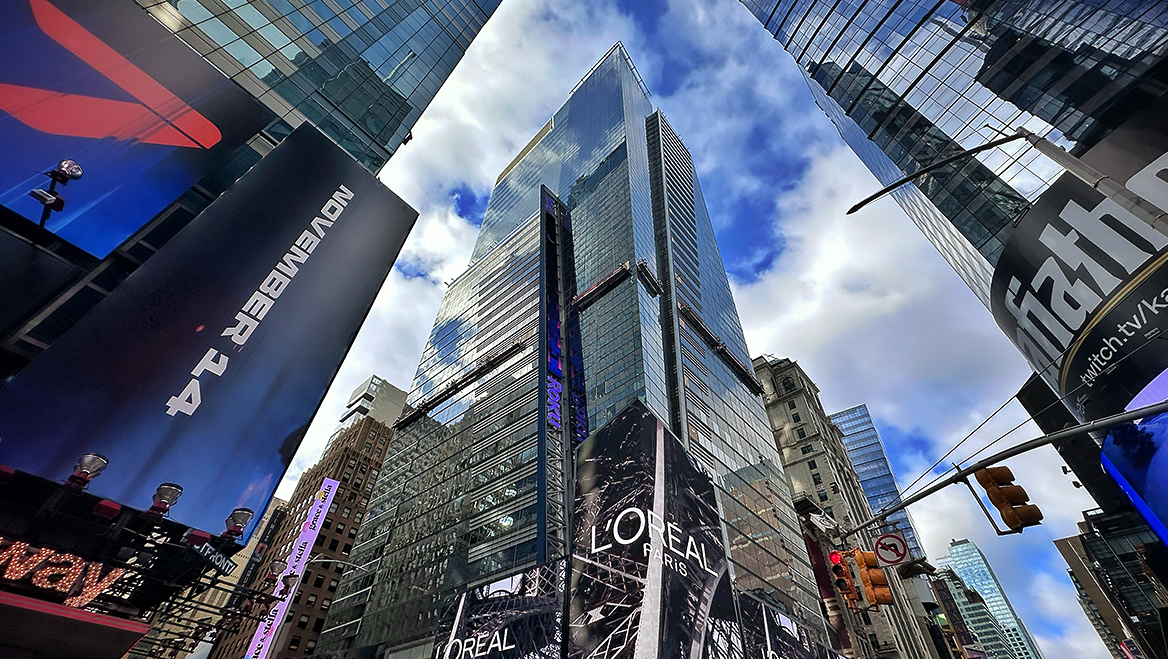
A City of Yes conversion opportunity came knocking at 5 Times Square, a 38-story building with a quarter of its 1,250 rental units slated to be affordable. Photo by Michael Young.
Before City of Yes, conversions from office to residential were mainly limited to Manhattan (below 60th Street) and parts of Brooklyn and Queens. Regulations restricted conversions to buildings built before 1961 (or 1977, in some locations), and structures couldn’t be converted to shared housing types, like dormitories.
The new rules made conversions acceptable citywide, reset the cutoff date for eligible buildings to 1991, and eliminated the shared-living space ban. This opened the door to adapting not only old or underused office spaces but also schools, religious buildings, and other community facilities.
At the same time, the state passed the Affordable Housing from Commercial Conversions Tax Incentive Benefits to help projects pencil out. “It brought affordable housing into the conversation,” Mangin says. “It requires a percentage set aside for that, which is awesome because one of the critiques of conversions in the past is that you’re just converting to luxury market-rate units.”
The tax incentive states that at least 25 percent of the six or more units must be affordable. It also provides a bigger tax benefit if developers file by a certain date. “It led a lot of projects that might’ve been on the fence to move more quickly, such that we have an enormous conversion pipeline now, with lots of affordable housing,” Mangin says.
Emma Waters, a senior housing policy analyst for the Bipartisan Policy Center, says that tax incentives often help projects make financial sense because converting older buildings often requires expensive changes to make them functional.
Since December 2024, City of Yes has been credited with helping to bring 13,700 proposed residential units to life in 44 office-to-residential projects. In total, the reform efforts have led to 53,337 permitted housing units for alterations or new buildings — meaning they have been approved by the Department of Buildings and construction can start.
These and subsequent reform efforts in New York City eased the way for a conversion at 5 Times Square, a 38-story building in Manhattan. The project will add 1,250 rental units — 313 of which will be affordable for people earning up to 80 percent of the area median income — to 917,745 square feet of vacant office space. It will mostly consist of studio apartments, with just 200 one-bedroom units. Construction is underway, and the first phase should be completed in 2027.
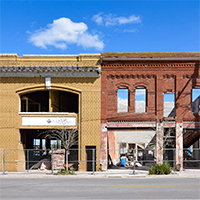
Better Zoning for Reuse and Redevelopment examines how zoning rules and procedures can better accommodate reuse of existing buildings and land redevelopment
Waters admits she has been pleasantly surprised by the effectiveness of City of Yes. She acknowledges that this effort, and office-to-residential conversions in general, won’t solve the housing crisis, but she thinks they are significant pieces of the puzzle.
“There’s no reason not to try to find ways to use land and resources more effectively,” she says. “Housing demand is always going to be there, but there has been a lot of uncertainty over the last couple of years about how much people are going back into the office.”
Adaptive reuse remains relevant
New York isn’t the only place to say yes to office-to-residential conversions. In Office-to-Residential Conversion: Case Studies and Policy Tools, a report for the Office of Policy Development and Research of the Department of Housing and Urban Development, researchers studied six cities that used adaptive reuse to build more housing.
“It makes the built environment more flexible,” says Tracy Hadden Loh, a fellow at the Brookings Institution and one of the study co-authors, “and, especially in a time of greater uncertainty, who doesn’t want maximum flexibility — or, if you can’t have maximum, at least more?”
Hadden Loh says the study authors wanted to understand the market contexts in which office-to-residential is relevant. The answer? “It is, even if it is niche,” she says. “It’s real, but it does different things in different places.”
The study found that, in Stamford, Connecticut, new housing supply is constrained, but demand is high. With adaptive reuse, existing building envelopes and the parking that come along with them “are essentially like a portal to new housing that the community is willing to accept,” Hadden Loh says. “Because there’s such tremendous demand, Stamford is the one market we studied where every single office we looked at, the economics of conversion were positive.”
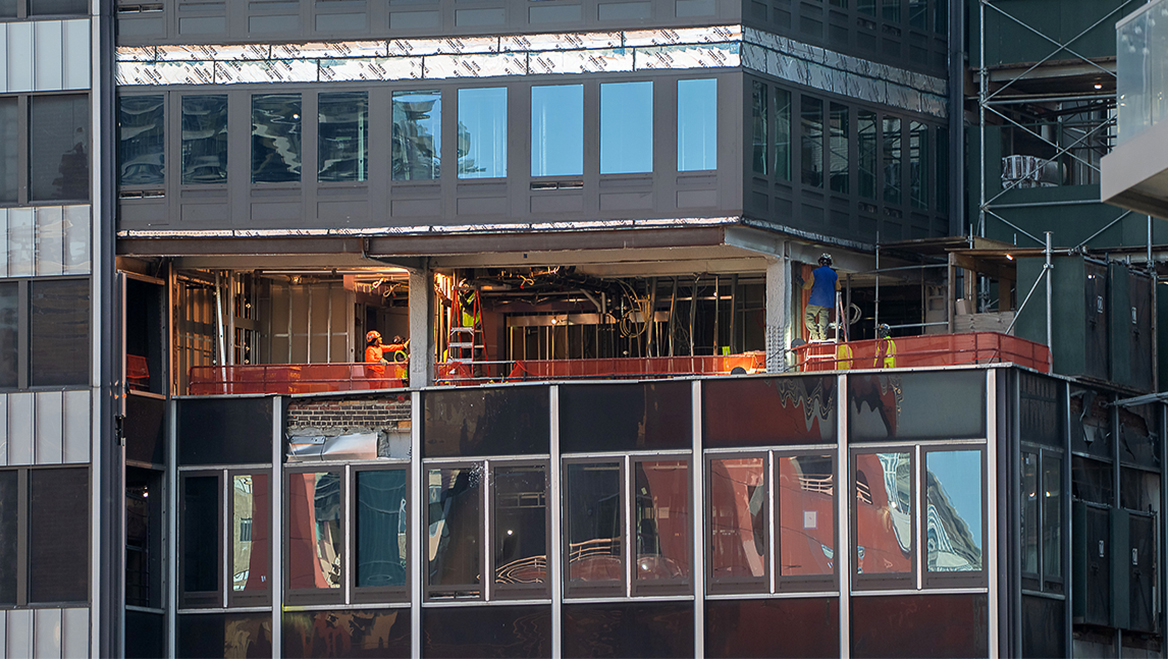
Despite the success of some office-to-residential conversions, structural issues paused construction at the former Pfizer building in midtown Manhattan. Photo by Hiroko Masuike/The New York Times.
Meanwhile, Winston-Salem, North Carolina, is home to both a thriving middle class and strong new housing production. The push for conversions was helped along by the desire to revitalize downtown, including beautiful and beloved Art Deco office towers. The city’s generous tax abatement policy helps make that happen.
Overall, the researchers identified three key findings: Clear housing demand tends to drive successful conversions; tax incentives and other financial tools are essential; and outdated codes can become a barrier.
‘A powerful message’
Back in New York, while City of Yes has yielded success stories, it hasn’t been without a few bumps.
A handful of conversion projects have stalled because of structural issues, including steel support beams buckling during construction on one building and a cracked concrete beam discovered in another. An ensuing review of 180 proposed conversion sites found no immediate danger to the public, according to city officials, although 60 violations were cited and 19 work sites were temporarily shut down.
Despite those setbacks, Mangin is optimistic that City of Yes has lived up to its name and has created more places for people to live. “We expect we’ll relieve some of the pressure on the housing market [here],” he says.
Mangin also hopes planners in other cities take this lesson from City of Yes: “Just a little bit of housing everywhere is such a powerful message,” he says. “It changed the conversation in a really productive way for planners, for neighborhoods, for the City Council, and for everybody.”
RECOMMENDED ARTICLES