


New Toolkit Provides Gender‑Inclusive Mobility Strategies for Planners
summary
- Modern transportation systems are largely designed around a traditional male commuter model, creating safety, cost, and accessibility burdens for any other users.
- Strategic planner Leah Gerber, AICP, argues that gender‑inclusive mobility planning leads to better outcomes for everyone.
- The American Planning Association interviewed Gerber about her recently published A Toolkit for Gender Inclusive Mobility Planning, which offers practical guidance and case studies to help planners design transportation systems that reflect diverse, real‑world needs.
Modern mobility and transportation systems have been designed primarily with men in mind. It is a reality that makes it harder on those who don't — or can't — travel during a default male user's schedule.
How does this manifest in a real-world scenario? Leah Gerber, AICP, a strategic planner in Detroit and former German Chancellor Fellow, plays out an all-too-common scenario. Imagine, she says, a woman who relies on public transit. Now, the city doesn't have flat fares, but the woman is worried about traveling alone on that line at night. So, she spends more money on a rideshare just to feel safer on her commute home.

Leah Gerber, AICP, author of A Toolkit for Gender Inclusive Mobility Planning.
Now imagine another scenario: a mother stops to pick up her child, goes to the grocery store, and grabs a prescription before heading home. Each stop adds time, transfers, and potentially additional cost — especially in a system designed around a single, direct commute. "The concept of trip chaining, or linking multiple non-work trips, comes up a lot," Gerber says.
To help planners ensure that every person can move freely and safely from the first mile of their journey through their last, Gerber created A Toolkit for Gender Inclusive Mobility Planning. The free downloadable resource includes best practices and case studies to make gender-inclusive mobility planning more accessible and actionable.
"Gender-inclusive mobility planning and design is a nuanced topic that varies based on culture, geography, and population and cannot be covered in one document," Gerber notes. "This toolkit is meant to be a starting point for re-examining mobility planning on the local level, and I hope planners can adapt and build on it to reflect the specific needs and lived experiences of their communities."
Gerber spoke with American Planning Association Senior Editor Jon DePaolis about the toolkit, which was published earlier this year, and expanded on how planners can incorporate its lessons into their work today.
JON DEPAOLIS: What did your research show in terms of the impact gender-inclusive approaches had in mobility planning, street design, and policy?
LEAH GERBER: Research and practice show that gender-inclusive approaches benefit everyone.
For example, having well-designed bus stops with good lighting, seating, and real-time schedule information improves the experience for all riders. Similarly, widening sidewalks and adding curb ramps encourages more pedestrians while making the streetscape more accessible for someone using a wheelchair or mobility assistive device.
DEPAOLIS: What are things planners can do right now to create better outcomes and communities for all transportation users?
GERBER: The data-gathering process for mobility projects doesn't always include gender differences, especially regarding differences in travel behavior. This is often referred to as the "gender data gap," and it means that planners are potentially missing out on the needs of more than half of the community.
One way to address this is through gender disaggregated data, or data collected and tabulated separately for each user. Disaggregated data may help show how the travel behaviors differ from the assumptions embedded in current mobility systems. This is something planners can do early in the planning process that can lead to better outcomes.
DEPAOLIS: If you were walking someone through this toolkit, how would you recommend they use it in their current work or to guide the conversations they are currently having?
GERBER: The toolkit is organized around key phases of the planning process, with each section outlining how gender-inclusive planning and design can be applied based on relevant literature and current practices. Sections also highlight case studies from a range of cities, which I find helpful as a planner because they show tangible outcomes.
I recommend starting with the introduction because it establishes the foundational knowledge and framing. From there, readers can read through the full document or jump to whichever phase of the planning process they're most interested in. There is also a Practitioner Guide, which is a condensed version of the full toolkit, designed for users who need a concise review. It highlights the key points and recommendations, allowing readers to quickly grasp and apply key guidance without reading the entire toolkit.
DEPAOLIS: What do you hope your peers take from this free resource?
GERBER: That everyone travels differently, and that difference matters. Mobility systems have long been designed around a narrow commuter model. But people's travel behaviors are shaped by factors like safety concerns, caregiving responsibilities, and life stage, among others. By applying the concepts in this toolkit, planners can better recognize and respond to how people move throughout their daily lives.
It's also essential to recognize and understand that today's travel behaviors have been shaped by history. While gender-related needs were often underrepresented through omission, race and class were frequently the basis for intentional discrimination. Practices such as redlining and the construction of highways destroyed Black and Hispanic neighborhoods and continue to influence how people move today. Understanding this history is critical. Gender-inclusive planning must be grounded in intersectionality and avoid treating all riders as one homogeneous group. Mobility needs are shaped by overlapping identities and lived experiences, which is where approaches like co-design and community-based research come into play.
I also hope planners see that gender-inclusive mobility connects to broader ideas like the 15-minute city and universal design. When we plan for accessibility, proximity, safety, and flexibility, we're not just improving transportation; we're strengthening the built environment. Ultimately, this work is about creating communities that serve everyone more effectively.
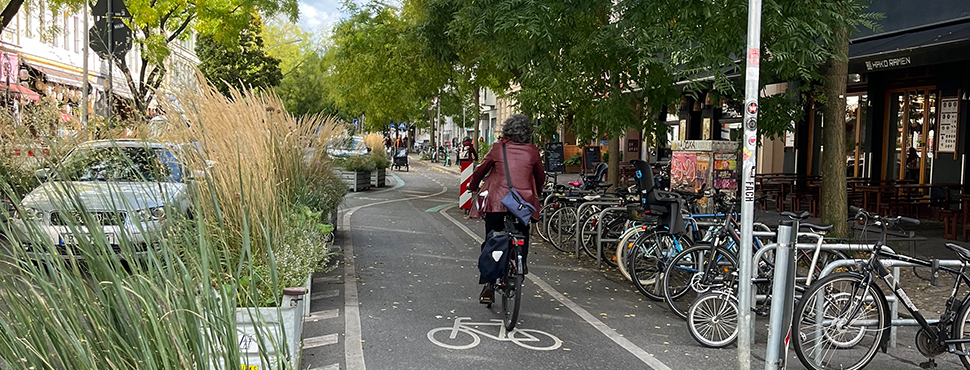
Top image: A bike lane in Berlin, Germany, shows how planners can create a safety barrier between traffic and pedestrians while also using bump-outs and planters to create a greater sense of safety for users. Photo courtesy of Leah Gerber.
About the Author