


2026 Advancing Diversity and Social Change in Honor of Paul Davidoff Award
Pu'uhonua o Wai'anae: A New Model for Permanent Housing
Dynamic Community Solutions and G70
summary
- Pu'uhonua o Wai'anae Farm Village Project is recipient of the 2026 APA Advancing Diversity & Social Change Award in Honor of Paul Davidoff.
- The project transformed a houseless community of about 250 people, more than two-thirds Native Hawaiian, into a farm village that integrates permanent housing with farming, cultural practices, gathering spaces and shared stewardship.
- Planners and technical experts supported the community's vision rather than imposing an outside model. Engagement was rooted in relationships, listening and translating community knowledge into land, policy, infrastructure and implementation.
On the shores of Wai'anae Boat Harbor, roughly 250 people built a self-sufficient community for the unhoused, Pu'uhonua, of which more than two-thirds are native Hawaiian. Residents looked after one another, cared for children collectively, and established rules that supported village life, grounded in mutual responsibility, cultural connection, and care for one another. Pu'uhonua residents had faced a multitude of issues including land dispossession, economic exclusion and trauma, and failure of public systems unable to address their complex lives.
When facing eviction in 2018 due to health, safety and land use concerns, the conventional response might have been to move residents into separate shelters or housing programs. Instead, the community pushed for a solution that would keep the village together.
That decision set in motion the Pu'uhonua o Wai'anae Farm Village Project, a 20-acre effort to create permanent housing, agriculture, gathering spaces and a system of community self-governance. The project emphasizes how community knowledge and lived experience can restore dignity.
The Challenge that Changed Pu'uhonua
Village leader Twinkle Borge and other community leaders met with then-Governor David Ige and advocates from Hui Aloha to work toward a solution.
"Oftentimes, we receive people on the worst days of their lives, without a sense of hope, a sense of belonging, a sense of worth. The purpose of what the Pu'uhonua is all about, is to give them a place they can call home to wake up their mana (spiritual authority)."
— Twinkle Borge
In December 2018, Gov. Ige issued an emergency proclamation suspending certain laws and administrative processes to expedite housing options, giving the community additional time to find a permanent housing solution. Dynamic Community Solutions, the nonprofit created to carry the community's future forward, completed the acquisition of a new site in Wai'anae Valley in March 2020. The site was chosen for three main reasons: it was nearby in Wai'anae, allowing residents to stay close to their families; it was roughly 20 acres, comparable in size to the existing site; and, most importantly, it was available for purchase and immediate relocation.
More Than Just Providing Housing
Pu'uhonua was already an alternative to conventional shelters, a place where people could heal, contribute, and remain connected to community. That philosophy shaped the new village, where housing, agriculture and community life are designed to work together. It contrasts with conventional responses to houselessness, which move people through systems without restoring the relationships that make healing possible.
Housing Around Shared Spaces
The plan organizes 200 Lōkahi housing units into 11 clusters, each serving roughly 20 to 25 residents. Shared kitchens, restrooms, and indoor-outdoor dining areas help reduce infrastructure and construction costs while creating spaces for residents to cook, eat, and care for one another.
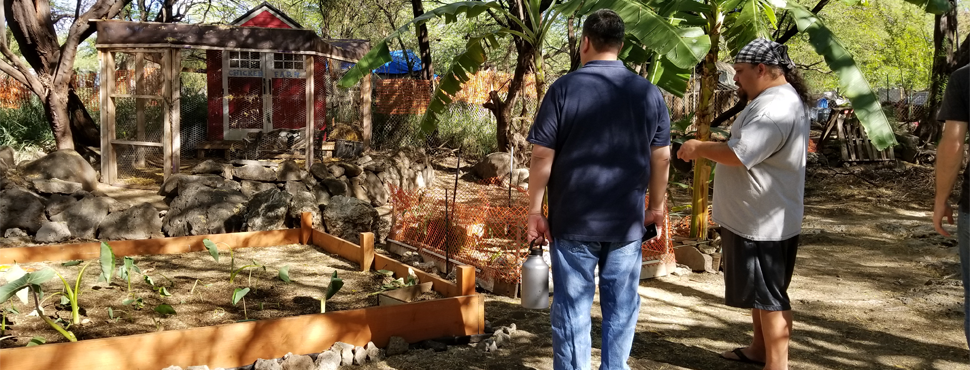
The site plan also incorporates a farm to support local food production. The farm has three goals: produce enough food for residents, share food with the wider Wai'anae community, and sell the excess crops.
To make the land productive for farming, the residents worked with local farmers and agricultural experts, including the University of Hawai'i, to develop a plan suited to the land. 'Ulu, or breadfruit, is planned for lower elevations with better water access, while mango will be planted at higher elevations.
Together, the housing and farm plans reflect a larger idea: this is not simply a place to house people. It is a place designed to sustain a community.
Connecting the Whole Community
As the new village took shape, residents reached out directly to surrounding neighbors to proactively address misconceptions that equated houselessness with crimes or trespassing. The goal was not simply to explain the project, but to address concerns and build relationships. That approach carried into the site's design.
Instead of treating the edge between the village and neighboring properties as a hard boundary, the project envisioned a landscape of 'ulu, banana and other food-producing trees. What could have functioned as a dividing line could instead become a shared garden and gathering space.
It is a small example of a larger planning principle at work: the project consistently looks for ways to turn separation into connection.
Planning From Community Knowledge
Today, at least 100 residents have moved into permanent homes, half of the planned housing units have been built, agriculture is underway, and infrastructure continues toward full build-out.
The project demonstrates what is possible when planning remains grounded in helping uplift people by building trust and empowering individuals.
For Pu'uhonua o Wai'anae, that future is rooted in a simple idea: aloha lives here.
2026 Advancing Diversity and Social Change in Honor of Paul Davidoff Award
Pu'uhonua o Wai'anae Farm Village Project
Wai'anae, O'ahu, Hawai'i
Project Partners
- Atelier 5
- Central Plant Repair, LLC
- Control Point Surveying
- Cultural Surveys, Hawai'i
- G70, planning and engineering
- Habitat for Humanity
- Hawai'i Wildfire Management Organization
- HomeAid Hawai'i
- A&M Developments
- Wayfinder Pacific
- Hale Partners
- Hui Kū Maoli Ola
- JAS Architects
- Kai Engineering
- Hui Alhoa
Top image: Courtesy of the Pu'uhonua o Wai'anae Farm Village Project team.
ABOUT THE AUTHOR