
Uncovering JAPA
A Better Framework for Scenario Planning

The Journal of the American Planning Association (JAPA) turns research into action. All APA members have access to JAPA and its full archive as a member benefit.
Summary
-
A new framework shared in the Journal of the American Planning Association (JAPA) helps metropolitan planning organizations (MPOs) integrate racial equity into scenario planning.
-
The framework moves beyond evaluating scenario outcomes, encouraging planners to consider equity throughout how scenarios are developed.
-
Five types of racial equity planning, the stages of scenario planning and three outcomes of public-sector scenarios are integrated into a single framework.
Regional metropolitan planning organizations (MPOs) use scenario planning to prepare for an uncertain future. While regional planning may wish to incorporate equity planning to acknowledge the history of inequitable processes and address disparities, MPOs often lack the scripts and frameworks for action.
In "A Framework for Using Regional Scenarios in Racial Equity Planning" (Journal of the American Planning Association, Vol. 92, No. 2), Daniel L. Engelberg offers regional planners a way to promote and evaluate the role of equity in scenario planning.
A New Framework for Improving Equity in Scenario Planning
Engelberg created a three-dimensional equity framework that helps improve equity in scenario planning to ensure that our scenario planning process, typically focused on outside uncertainties, doesn't replicate internal inequities. The author incorporated the five types of justice, the stages of scenario planning and three outcomes of using scenarios in racial equity planning. Three questions guided this novel framework.
-
How can scenario planners promote five types of justice (distributive, deliberative, procedural, restorative, and epistemic)?
-
What can planners do in each scenario planning stage to promote racial equity?
-
How can scenario planning outcomes support racial equity?
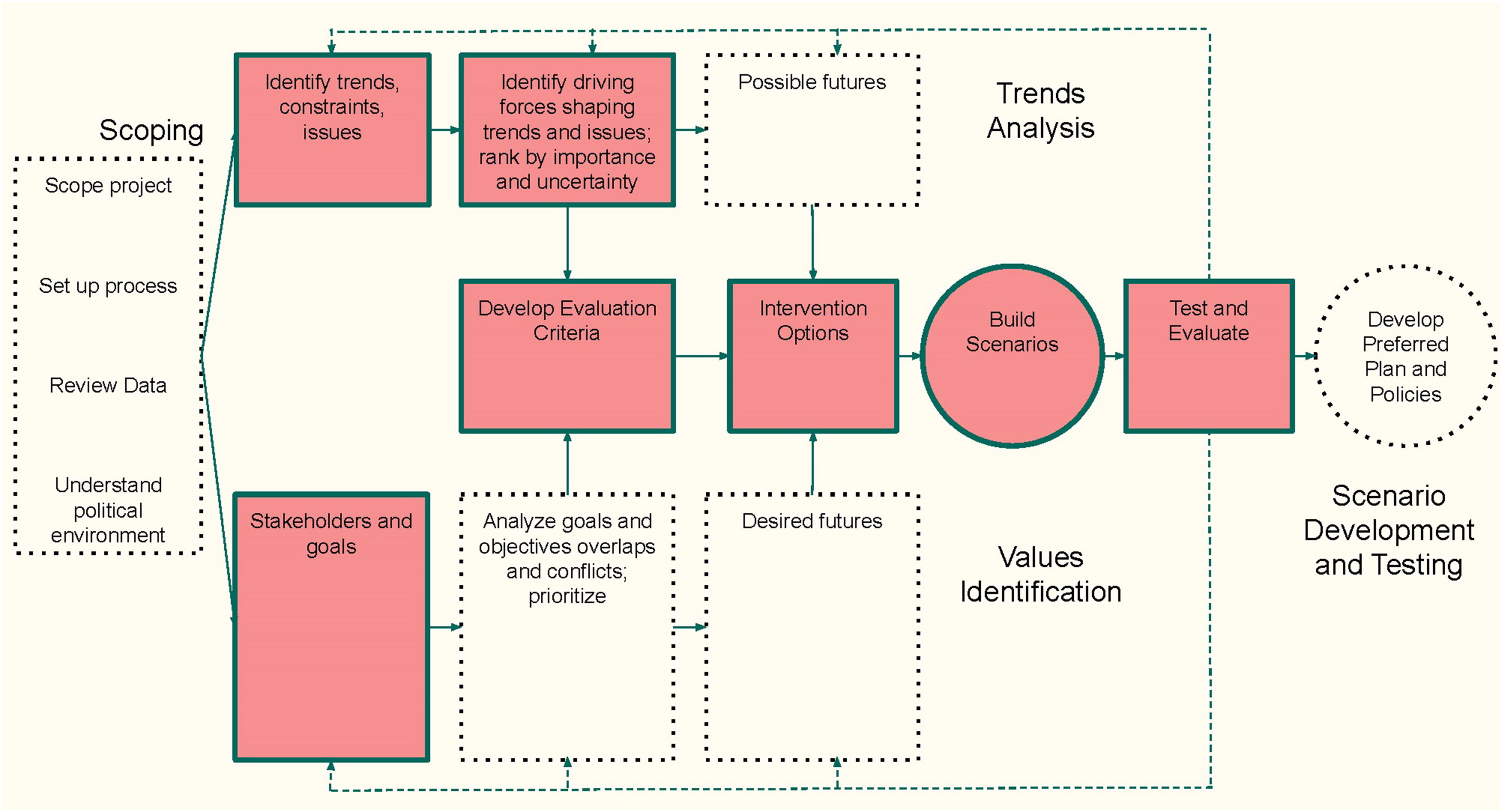
Figure 1:The scenario planning process. Steps included in equity framework have a solid outline (Credit: Author).
Among the scenario planning process, several of the steps are not strictly related to scenario development: developing evaluation criteria, selecting intervention options, and testing and evaluation. These steps can be done in conjunction with the scenario process or afterward. However, Engleberg emphasizes that these steps are essential to advance racial equity.
The framework can be used to support racial equity for three scenario planning outcomes: organizational learning, organizational strategy, and community learning. Each relies on diverse perspectives and attention to power dynamics so that voices often excluded from planning processes are heard.
For success, Engleberg recommends developing scenarios with communities, rather than simply about them.
Engleberg's paper was awarded the 2026 JAPA Emerging Scholar Award in October during the Association of Collegiate Schols of Planning (ACSP) annual conference.
Top image: Photo by iStock/Getty Images Plus/ tadamichi