


July 16, 2026
After a night out in Austin, Texas, in the summer of 2025, I tumble into an Uber to head to my hotel. I like to get the inside scoop from local drivers when I travel, so with the college football season about to start, I’m curious: Can star quarterback Arch Manning live up to the hype?
I never get the chance to ask, though, because no one is at the wheel of the driverless Jaguar electric vehicle (EV) that Uber sends to pick me up.
The trip was one of a half-dozen driverless taxi rides I took during that long weekend in Austin, a city that considers itself the “Kitty Hawk” of robotaxis, according to former mayor Steve Adler. It was an early proving ground a decade ago, when Google’s self-driving project expanded beyond California, but robotaxis are now sweeping across the country like tumbleweeds on the Texas range.
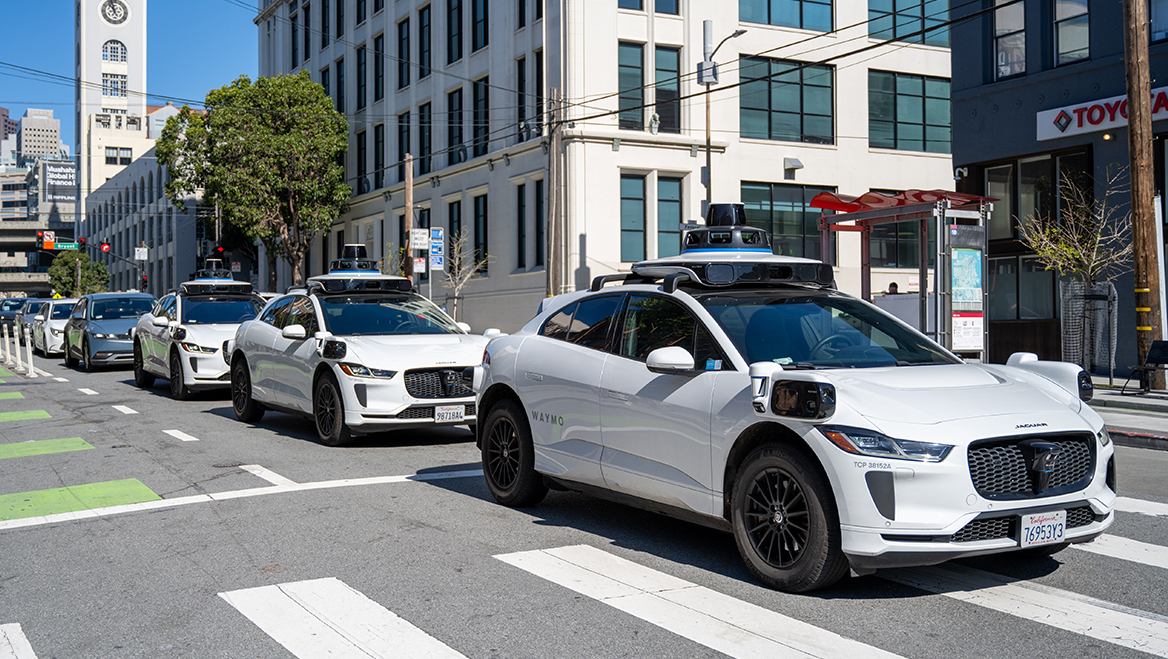
Waymo, for example, offers fully autonomous ride-hailing services with 3,000 Jaguar sedans in 11 cities — and more are on the way. The company provides the artificial intelligence (AI) and brain of the robotaxi; Jaguar adds the luxury EV; and Uber — or in some cities, Waymo’s own Waymo One app — offers its passenger distribution network, connecting riders to the technology. Researchers at the Boston Consulting Group say U.S. robotaxi fleets — including Waymo, Tesla, Amazon’s Zoox, Volkswagen, and others — will grow to about 350,000 vehicles by 2035.
Autonomous vehicles (AVs) have the potential to ease traffic congestion, boost individual mobility, and influence future land use by reducing the space required for parking personal vehicles. However, they also raise questions about safety risks in an urban environment. Balancing those pros and cons has to be collaborative, Adler says, and “the degree to which technology companies and cities can see themselves as partners in improving quality of life will determine whether we end up in a better place.”
The American Planning Association’s Autonomous Vehicles (AV) Research KnowledgeBase collection is a resource to help members navigate AVs by providing materials, guidance, and ongoing research.
State laws often define what local governments can regulate, and that determines how much control planners may have over AV fleets. Creating clear plans for robotaxi operations that set goals, priorities, and expectations is important to ensure that the technology supports public transportation, equity, and sustainability.
“Under current regulatory frameworks, city officials have few — if any — tools to align these companies’ operations with city goals,” says Josh Naramore, a senior program manager for policy at the National Association of City Transportation Officials (NACTO), which published a guide to help cities navigate the onslaught of robotaxis with local permitting, emergency access planning, and other strategies.
A good place to start at the local level could be curb lane management, says Eric Iwersen, a longtime planner who is now director of transportation and sustainability in Tempe, Arizona. AVs have cruised the streets of the greater Phoenix metro area since early 2020. Today, more than 700 fully driverless vehicles are publicly available through the Waymo One app or from Uber, covering about 315 square miles in the area.
Tempe’s curb lane management is a key driver in regulating where robotaxis can and cannot stop along the city’s more than five-and-a-half miles of curbside space downtown, Iwersen says. This ensures AV operability within its multimodal transportation network, which combines citywide bus service, light rail, the downtown streetcar, ADA paratransit, and 25 miles of bike lanes.
Another tool is geofencing, which uses GPS or network data to create virtual boundaries that limit where robotaxis can operate or where they may pick up and drop off passengers, often for safety reasons and sometimes in response to public feedback. “With multiple lanes of traffic, we have to isolate where those loading zones can be in an urban area,” Iwersen says.
Public safety concerns
Urban planners or public safety officers seeking additional advice may want to keep Lewis Leff’s number on speed dial. Leff, assistant director of transportation and public works in Austin, is the city’s point person for the day-to-day operations of AVs.
When for‑hire robotaxis launched in Austin three years ago, Leff says city officials first looked outward to their counterparts in Phoenix and San Francisco, where the vehicles were already on the road. Working with NACTO, Austin’s first responders learned from those cities through video calls and in training sessions organized by Waymo. Held at fire and police stations, the sessions combined classroom instruction with a hands‑on look at a static vehicle, allowing them to examine its sensors and systems.
Austin’s Transportation and Public Works staff have documented (as of publication) more than 300 autonomous vehicle (AV) incidents since launching its interactive dashboard in 2023. Dot colors refer to safety concerns, near misses, and collisions. Courtesy of City of Austin.
Building on that foundation, Austin assembled an internal AV working group that includes planners, staff from transportation, public safety, emergency response, public schools, and the airport to track how robotaxis are performing on city streets. When something goes sideways, the process is straightforward: Flag the problem, identify when and where it occurred, send the details to the company, and keep circling back until the fix holds. “There is no way to program every driving situation that these vehicles will have on the first iteration,” Leff says, “but we do expect the software to be changed, as opposed to changing how we do things.”
An example was a massive power outage in San Francisco last year, when Waymo cars froze, blocking intersections because the AVs couldn’t respond to blinking red lights.
Another problem is that robotaxis cannot interpret police hand signals. Viktoriya Wise, director of streets at the San Francisco Municipal Transportation Agency, has seen AVs slip around police during lane closures and fail to recognize hand signals when officers are directing traffic for a motorcade. The result: Officers must position a motorcycle right in front of each robotaxi to keep it from moving — “an unsafe and costly workaround,” she says.
Waymo uses “advanced machine learning models” to help the AV detect and respond to hand signals — an area where the company has made “great progress over the years,” company spokesman Ethan Teicher tells Planning.
Software companies say AVs are safer than cars driven by people. Waymo cites data from more than 170 million miles traveled showing that, compared to human drivers, it has achieved a 13-fold reduction in severe-injury crashes and crashes that injure pedestrians. The company believes one reason for this is its scenario-based Collision Avoidance Testing, in which the Waymo “driver” has learned to anticipate what other vehicles, cyclists, and pedestrians might do.
I saw Waymo’s ability to avoid a collision up close one night in Austin. A pedestrian in dark clothing darted across busy Congress Avenue. The car braked instantly, stopping inches from the pedestrian’s legs. I wondered: If it had been me behind the wheel, would I have been able to stop in time?
Still, Waymo received bad publicity in January after a taxi struck a child near a school in Santa Monica, California. While the child wasn’t badly hurt, it raised questions about AV use around schools. The company argues, however, that the ability of the car to brake quickly and slow from 17 mph to under 6 mph is what allowed the child to walk away without severe injury.
I saw Waymo’s ability to avoid a collision up close one night in Austin. A pedestrian in dark clothing darted across busy Congress Avenue toward the hood of the car as it cruised at about 20 mph. The car braked instantly, stopping inches from the pedestrian’s legs. I wondered: If it had been me behind the wheel, would I have been able to stop in time?
Revving up mobility options
With AVs making their way to more cities nationwide, it is easy to imagine a future in which cities are “completely choked” by autonomous cars, says Adam Millard-Ball, an urban planning professor at the University of California, Los Angeles. Two factors drive that possibility: AVs can stay on the road far longer than human drivers, and they can reduce the need for parking.
Todd Litman, executive director of the Victoria Transport Policy Institute in Canada, agrees but notes that while AVs can provide greater independent mobility for affluent non-drivers, industry experts often exaggerate their affordability and safety benefits — “and they overlook the increased traffic problems caused by both longer trips and emptier backhaul travel,” he says.
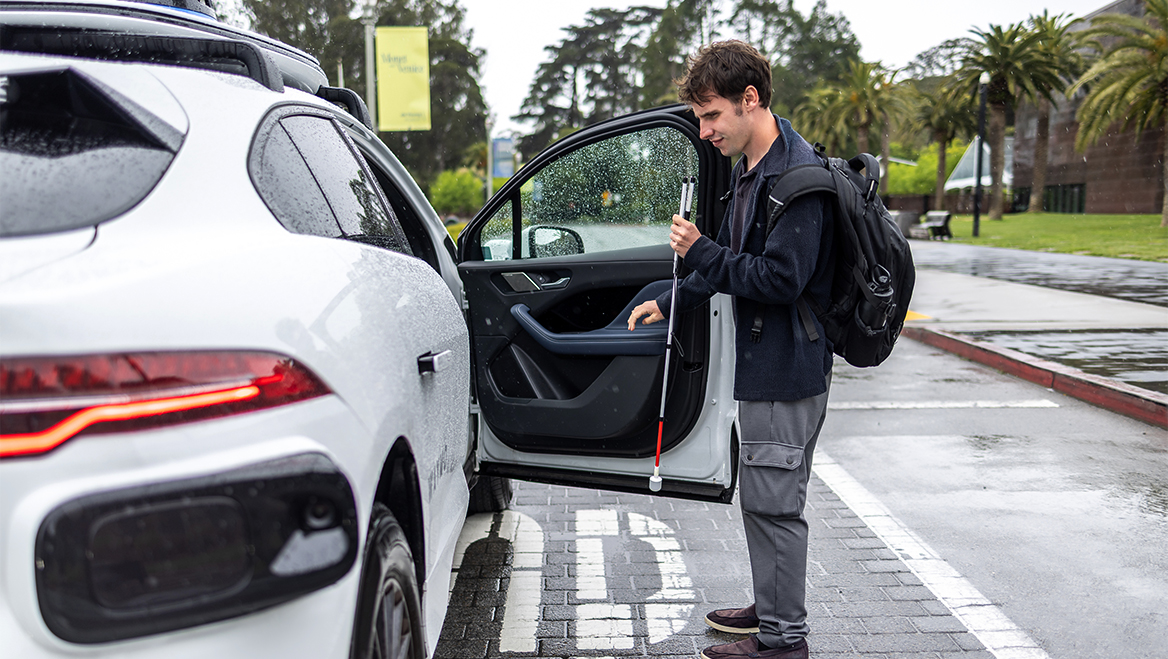
AVs may boost mobility for seniors and people with disabilities, including the visually impaired. Photo by Rachel Bujalski/The New York Times.
According to data reported to the California Public Utilities Commission, about 44 percent of Waymo’s vehicle miles in September 2025 were driven without a passenger on board, mostly while the vehicle was traveling to its next pickup or awaiting dispatch. To alleviate congestion, planners say cities may have to charge AV operators for road use or implement transportation demand management incentives that favor shared over private autonomous travel.
Meanwhile, AVs may boost mobility for seniors and people with disabilities, including the visually impaired. One person with firsthand experience is Claire Stanley, director of advocacy and governmental affairs for the American Council of the Blind. Stanley uses a guide dog to get around the Washington, D.C., area where she lives and works. Ride-hailing drivers frequently turn her away. “I am denied rides left and right, because people don’t want my dog in their car,” she says.
However, Stanley remembers a good experience from 2025 when she rode in an AV while visiting the West Coast. “I was almost 37 years old at the time and had never been in a vehicle by myself before,” she says. “Just that feeling of independence was the coolest thing ever.”
NACTO believes planners can take the lead by defining what equal access to robotaxi services means locally and ensuring that fleets accommodate people with disabilities, including those who use wheelchairs or other assistive devices.
For me, hailing a robotaxi from Uber was seamless. Inside, a display for passengers showed a detailed 3D map of the street around us. The car 'saw' the world in a way that was both precise and uncanny.
Stanley hopes Waymo’s AVs will soon be ready in D.C., where plans to put them on the road have stalled. “Those of us who are blind or have low vision for the most part can’t drive, so we rely on public transit, ride-share companies, or even just family and friends to get around,” she says. “In suburban and rural areas of the country, people might not even have access to public transportation, so this is a new tool that we can use.”
For me, hailing a robotaxi from Uber was seamless. The app gave me the option to select a car with no human driver at the wheel. When it arrived, an “unlock door” button appeared on my phone — a safety feature that lets only the client release the flush rear door handles. Inside, the vehicle’s cameras and sensors continuously interpreted its surroundings. A display for passengers showed a detailed 3D map of the street around us, with pedestrians, cars, objects, and lane markings outlined in real time as we approached an intersection. The car “saw” the world in a way that was both precise and uncanny.
Will the federal government take the wheel?
While cities are working with AV operators to refine local regulations, advocates are pushing for national oversight. Strong, safety‑focused regulation from the National Highway Traffic Safety Administration would be ideal, although until federal laws exist, cities and states should not be blocked from regulating AVs, says NACTO spokesman Alex Engel.
Industry groups, like the Autonomous Vehicle Industry Association (AVIA), want the federal government to establish uniform rules, national data reporting, and updated safety standards. Critics say that approach, however, prioritizes deployment over addressing the impacts on street safety, congestion, and emergency response. Leff, of Austin, says national legislation may help standardize oversight of robotaxis, but agreeing on core principles could be difficult. “The challenge is California sees things quite differently than Texas, which might see things differently than Tennessee,” he says.
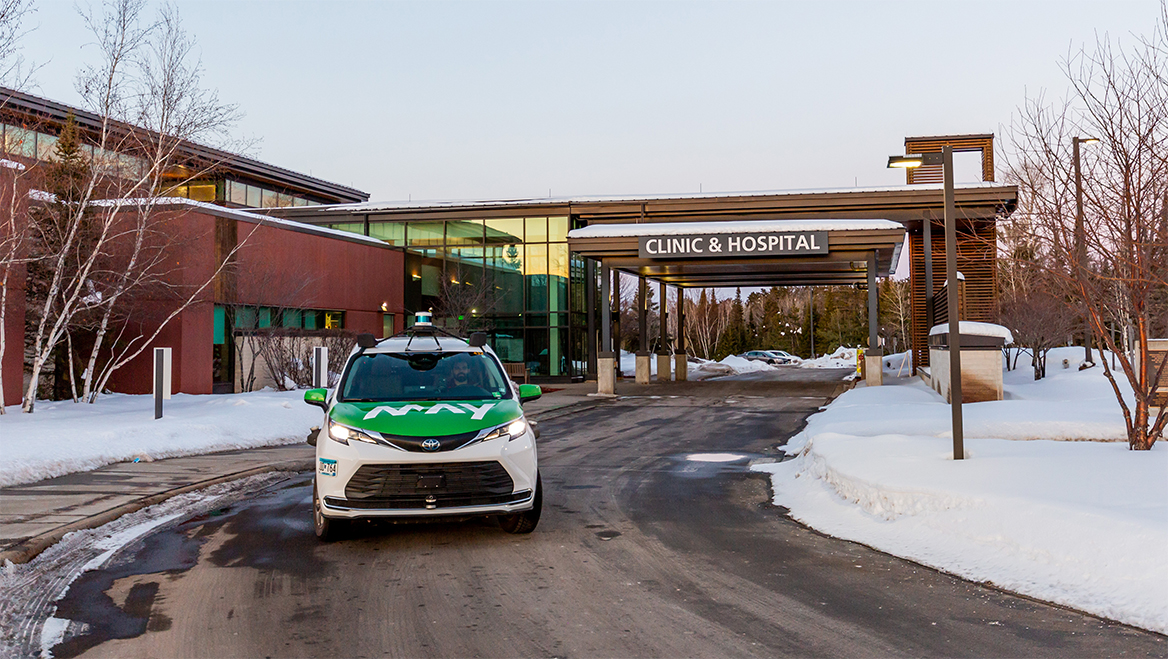
Grand Rapids, Minnesota, and similar small communities lack transit options, but city and state partnerships launched the goMARTI pilot program in 2022 to help address this. Now, it has an updated fleet of on-demand AVs serving a 20-square-mile area with more than 150 pickup and drop-off points. Photo by May Mobility.
One of those differences may lie in how city planners expect large‑scale AV fleets to reshape future land use and urban design. If shared AVs reduce private car ownership, for example, they could ease demand for parking in buildings and at the curb, potentially leading to a less auto-centric design philosophy that envisions fewer parking spaces, more housing, and more green space, says Suvidha Bandi, AICP, a planning manager in Houston, where Waymo began commercial operations in May.
Improving life in smaller cities
Right now, robotaxi deployment is concentrated in large metropolitan areas where ride-hailing is prevalent, but this technology also has the potential to improve the quality of life in rural communities, says Wei Li, PhD, a professor of urban planning at Texas A&M University. “There are over 18,000 small towns in the U.S. with populations under 50,000 that are completely underserved by traditional transit and AVs,” he says. “These communities are home to mobility-challenged populations in dire need of transportation services and the reliable delivery of essential goods, groceries, and medical supplies. AVs have the potential to truly empower these small communities, yet the industry has largely ignored them.”
Li notes that because AVs use onboard cameras, radar, Light Detection and Ranging (LiDAR), and artificial intelligence to navigate their surroundings instead of expensive “smart city” tools such as embedded road sensors or dedicated lanes, small municipalities don’t need massive capital budgets to accommodate them. However, he cautions that AVs could improve livability only if cities treated them as part of a shared transit ecosystem, rather than a one-to-one replacement for private cars. Success, he suggests, will mean using AVs to solve specific local problems, such as establishing an autonomous shuttle loop to connect a rural neighborhood to a medical clinic.
Back in Tempe, Iwersen says robotaxis have neither increased nor reduced traffic congestion in a city of 190,000 residents within a metro area of 4.5 million. Still, while AVs add another mobility option, they are no substitute for high-capacity public transit. “Definitely, there is a place for them,” he says, “but we still believe it is very important to have a robust, successful public transit program that can transport the greatest number of people in the most efficient way.”
RECOMMENDED ARTICLES