
July 23, 2026
As a native Houstonian and the resilience and hazard mitigation planning manager at Freese and Nichols, Ryan Slattery, AICP, talks about the impacts of severe weather and the critical importance of planning for resilience all the time.
But some conversations can be uncomfortable or contentious. For Slattery, those are situations worth leaning into. Over the years, he has honed his communications skills by listening, choosing his words thoughtfully, seeking common ground, and, frankly, “getting it wrong a lot.”
Slattery, who previously worked in the resilience space for Harris County, Texas, and the city of Houston, spoke with American Planning Association Editor in Chief Meghan Stromberg on a recent episode of People Behind the Plans. Their conversation has been edited for length and clarity. Listen to all of it at planning.org/podcast.
MEGHAN STROMBERG: How does Houston’s history with major storms shape resilience planning today?
RYAN SLATTERY: If you asked my mom, I wasn’t born in 1983, I was born the same year Hurricane Alicia hit. We know where we were when Allison came to town, and Ike. It’s how we mark the passage of time — one storm to the next.
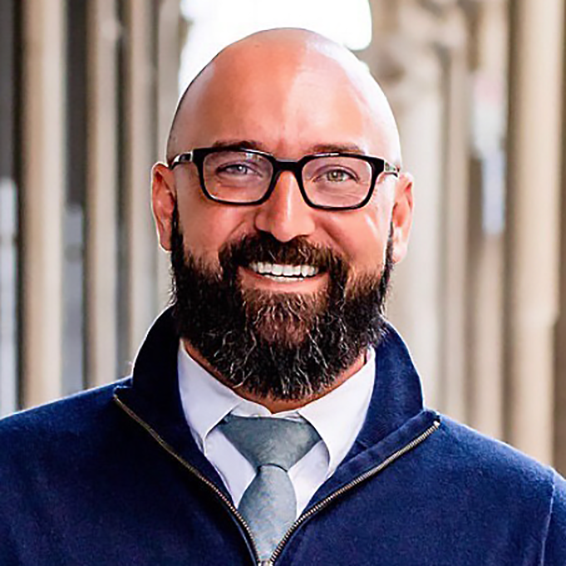
Ryan Slattery, AICP, is a resilience and hazard mitigation planner in Houston. Photo courtesy of Ryan Slattery.
We’ve seen several devastating hurricanes, but in addition to those storms, we also have to respond to things like global pandemics. COVID-19 was an opportunity for us to really understand how agile our resilience strategies were or are, particularly Resilient Houston. We released it in February 2020, had a global pandemic in March, and a year later, a winter storm. We really got to see how well that plan could adapt to those significant shocks and those prolonged stresses.
STROMBERG: Do certain terms land differently depending on the audience?
SLATTERY: It’s a conversation I have almost daily: how to be thoughtful about what I say, and to whom, as a professional.
Obviously, we have our personal feelings, but meeting people where they are is key. Words like resilience, equity, diversity, and inclusion carry different weights with different audiences.
Take climate, for example. We know it’s going to be hot in Houston, and the storms are getting bigger. Prolonged heat, inhospitable weather, conditions like hurricanes or derechos — I didn’t know what a derecho was until two years ago. These are realities that we have to respond to and plan for, irrespective of what words we use.
The meaningful conversation is: How do we protect communities? How do we protect infrastructure? How do we make the systems that we’re responsible for better prepared to absorb those shocks and stresses?
I don’t have to say “climate change” to talk to a community about hardening their infrastructure, or economic development, or community revitalization. I can use other words and find other ways to have the same meaningful conversation.
Planners need to have those conversations and not get lost in the blue versus red, the us versus them. We need to make sure that when we are talking to a community, we are meeting them where they are and having the important conversations about the systems that make it a good place to live, work, and play. That’s the end result that we’re all working toward, regardless of how you identify.
“You have to practice. You have to engage communities that don’t look like you. You have to shut up and listen, because the best way to absorb information and really flex that muscle is to be a thoughtful and engaged listener.”
STROMBERG: How do you move from disagreement to action?
SLATTERY: I like the debate. It’s important. The point-and-counterpoint is how we get to actionable solutions and meaningful programs, policies, and projects that are beneficial to the whole community.
But we’ve lost that willingness to engage in the debate, to be wrong. We need to find our way back to having those meaningful arguments.
Engaging in spirited debate doesn’t mean that I’m a bad person or you’re a bad person. It just means that we’re approaching the conversation from different perspectives. But when we drill down, we will all agree that roads are important, parks are important, housing is important.
STROMBERG: How have you honed your communication skills?
SLATTERY: Through getting it wrong a lot. You’re not just born a great orator or a great communicator; you have to flex these muscles. And if you don’t put yourself out there and have these conversations, you’re not going to learn how to make them better. You don’t just wake up and are good at hitting a baseball, so why would that not be true when it comes to having meaningful conversations?
You have to practice. You have to engage communities that don’t look like you. You have to shut up and listen, because the best way to absorb information and really flex that muscle is to be a thoughtful and engaged listener.
I don’t get the conversation right a lot, and I think that is an important reality for planners to consider. It puts us in a position to be wrong, which makes us vulnerable. People don’t like being vulnerable. But to be better planners, we’re going to have to be a little uncomfortable.
Some of the best data points I’ve ever gotten through community engagement are the criticisms — and sometimes those have a very Texas twist. I’ve been told there’s a lot of daylight between me and a good idea. One resident told me that my parents should get their money back. But those are good data points, because it tells you that you are not coming to this conversation in a way that is helpful or useful, and you need to make that adjustment.
So don’t just let it roll off your shoulders. Sit with it. Let it affect you because that’s what’s going to make you better, and you’re not going to make that mistake again.
RECOMMENDED ARTICLES