
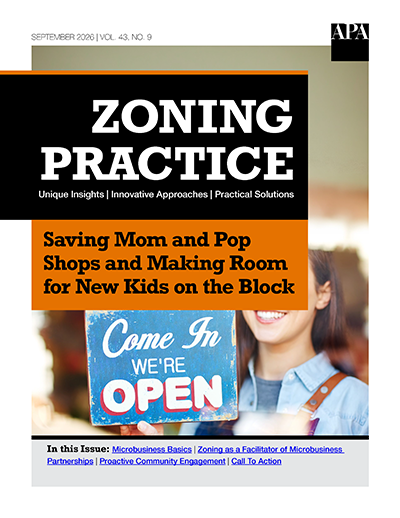
Saving Mom and Pop Shops and Making Room for New Kids on the Block
Zoning Practice — September 2026
By Jane Dixon, AICP, Ashley Jankowski, AICP
Not a member but want to buy a copy? You'll need to create a free My APA account to purchase.
Create account
Microbusinesses are woven into the fabric of nearly every community. Think of the hole-in-the wall sandwich shop with the bread that you swear by; the tiny used bookstore that has had the same guy behind the counter for decades; the young entrepreneurs who are incubating a new business idea in their garage; or the mom who decided to turn her baking passion into a side hustle. Collectively, these businesses bolster local economies, give life to our neighborhoods and main streets, and expand economic opportunity for creative, hardworking community members.
Zoning affects where microbusinesses can locate, their access to customers and foot traffic, and their ability to make customers aware of their businesses; yet so often, would-be microbusiness owners run into modern zoning codes that prohibit commercial uses and business signage in convenient, walkable, and affordable neighborhood settings. Beyond the physical impacts that zoning has on a microbusiness is an even larger barrier to entry: the time and cost associated with complex development and permitting processes, including expensive special land use procedures and multi-departmental business license reviews. Together, these challenges may be enough to keep an entrepreneur from pursuing their small business ambitions altogether. But the story doesn’t need to end here. Rather than serving as a hindrance, we can thoughtfully reenvision zoning as a facilitator of the partnerships necessary to actually make microbusinesses viable, visible, and sustainable.
This issue of Zoning Practice explores how zoning can help foster a thriving microbusiness economy in your community. It discusses opportunities for amendments that expand access to affordable, conveniently-located commercial spaces and highlight some novel examples of how communities across the country are pushing the envelope in their zoning administration in support of local entrepreneurship.
Details
About the Authors
Jane Dixon, AICP
Jane Dixon, AICP, is a Principal Planner who leads complex planning, zoning, and economic development initiatives that help communities realize their long-term visions for growth and reinvestment. With a focus on downtown and corridor revitalization, Jane specializes in crafting DDA and TIF plans that align public investment with community priorities, leveraging tax-increment financing as a tool for equitable economic development. Her work focuses on inclusive engagement, facilitating collaborative processes that bring together residents, business owners, and local institutions to shape practical, shared outcomes. Her background in zoning administration deepens her perspective on the practical challenges local business owners encounter, grounding her economic development work in on-the-ground realities. She holds a Master of Urban and Regional Planning from the University of Michigan and dual Bachelor’s degrees in History and Political Science from Oakland University.
Ashley Jankowski, AICP
Ashley Jankowski, AICP, is a Senior Planner at McKenna who collaborates with diverse communities across the Midwest to achieve land use, housing, sustainability, and economic development goals through tailored planning and zoning initiatives. Through the creation of customized development guides and comprehensive audits of zoning ordinances, Ashley helps to develop strategic recommendations that promote small business success and equitable entrepreneurship in communities of all sizes and capacities. An avid writer, listener, and freelance journalist, Ashley incorporates storytelling and creative communication throughout her planning work to build place-based narratives that strengthen community identity. Before becoming a planner, Ashley worked in environmental data management and sustainability strategy, helping cities and campuses build resilience with policy, education, and community-led projects. She holds a Master of Urban and Regional Planning and a Master of Environment and Sustainability from the University of Michigan, as well as a dual Bachelor of Arts in Environmental Studies and Journalism from New York University. Ashley is the lead writer of McKenna’s blog, Elevations, and her writing has appeared in the American Planning Association’s Zoning Practice.