

Targeted Online Harassment: Are You Prepared?

summary
- Driven by social media anonymity, political polarization, and declining civic discourse, targeted online harassment is an increasing risk for public-facing professionals — including planners.
- While you can't predict or prevent targeted online harassment, you and your organization can be prepared to respond if it happens by having a plan in place.
- Starting the conversation and developing a workplace culture that encourages reaching out for support helps ensure that no one faces targeted harassment alone.
Thousands of emails from strangers. Receiving endless DMs and being tagged on social media. Your phone is ringing all night, and hate mail is arriving at your home and office. Slurs or other troubling language appearing in messages about you that seem increasingly angry. Threats to your job, family, or even your life.
This is what it looks like to be the target of harassment by members of the public — a situation fed by the widespread use and anonymity of social media, increased political polarization, and a general decline in civic discourse.
As public-facing staff deeply engaged in often-controversial community issues, planners are increasingly at risk of facing such unwanted attacks. They could be triggered by something you said or wrote, a policy or initiative that you were involved in developing or implementing, a social media post you made, something you said in a public meeting, or even something from your private life.
What would you do if you found yourself the victim of such a campaign?
Be Ready To Respond
In my academic career, I have studied the targeted harassment of college and university faculty by members of the public. The findings and recommendations from my research have implications for professionals in a wide range of fields, including planning.
I frequently see generic advice to prevent harassment by cleaning up your social media and online presence. Although this might be one approach, it is not a one-size-fits-all solution for several reasons. People without social media accounts still experience targeted harassment. Even the most benign online content can quickly be taken out of context, and posts that seem innocent to you may be perceived as controversial to others. Finally, this approach seems to suggest that you should be responsible for preventing your own harassment, and it undermines personal expression and the right to freedom of speech in a democratic society.
Instead, my research has highlighted the importance of being ready to respond.
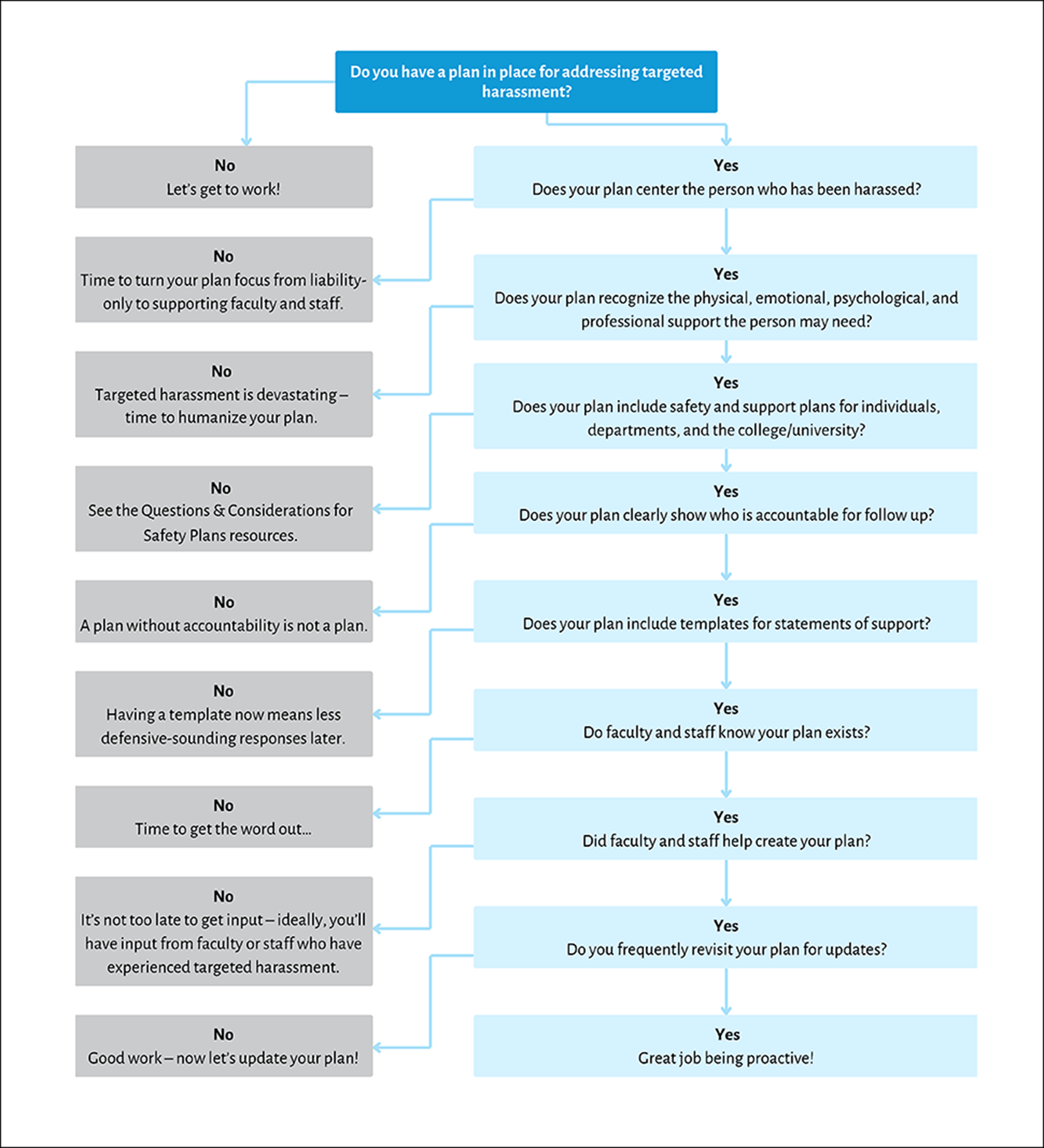
Be prepared by having a plan in place to respond to targeted online harassment. Adapted from Flores 2024.
Action Steps To Be Prepared
Now that we are living in a world where practicing planners may find themselves targets of harassment by the public, what can we do to be more prepared? Furthermore, what can we do to support others who may be experiencing harassment? The following recommendations offer a place to begin.
Start the conversation
The best time to start talking with your colleagues and your supervisor about the risk of targeted harassment is before it has occurred. Now is the time to open lines of communication and make sure that you, your department, and your organization are ready to act, not just react, if it happens. Can you add this as a topic for your next meeting agenda? Can you set aside time in the new year to learn more about
Have a Plan
Part of being ready is having a plan so that you, your colleagues, and your organization are not left scrambling during a period of targeted harassment.
- Do you know who to reach out to if you are targeted?
- Do you know how to take down your public profiles, especially those with your location or contact information?
- Do you know how to help a colleague if they are a victim of targeted harassment?
- Is there a department-level plan for support and safety if staff are targeted?
- Is there a check-in schedule for making sure no one is left handling targeted harassment on their own?
The flowchart above, created as part of my research as a fellow with the UC National Center for Free Speech & Civic Engagement, can help guide your process.
Create an organizational culture
When targeted harassment happens, it is overwhelming, and things move fast. In my research, people reported feeling isolated, being unsure whether it was safe to tell anyone, and taking on what they likened to a second job as they attempted to navigate the harassment alone. Create a culture in your agency or department in which colleagues know they can and should reach out to each other and supervisors for safety and support if targeted harassment occurs.
Preparation as Insurance
There is no way to predict who may be the target of online harassment, or when, or why. And we should not be scared to do our jobs, support our communities, or engage in important and meaningful work just because harassment is a possibility.
I think of preparation as a kind of insurance. Being prepared to respond to targeted harassment is far better than just hoping that it never happens to you.
And a key benefit of developing a plan and creating a culture within offices, departments, or agencies in which people are ready and willing to support each other is that if targeted harassment happens, you know what to do — and you know you are not alone. Together, we can all better navigate these times when it seems like anyone, including planners, may wake up to find themselves facing online harassment.
Top image: icafreitas / iStock / Getty Images Plus
ABOUT THE AUTHOR