


Spotlight on Zoning Practice
Are We Being Smart About Smart Growth?

Summary
- Critics often blame traditional growth controls for constraining housing production, but fiscally responsible development that aligns with smart growth principles is arguably more important than ever.
- Planners can be smart about smart growth by modernizing adequate public facilities (APF) rules to incorporate context-sensitive level-of-service (LOS) standards that align with a broader range of community objectives.
- However, success hinges on expanding planning capacity with better data governance, decision-support tools (e.g., digital twins, scenarios), and ongoing staffing and training.
Traditional growth management strategies are a tough sell for many communities. Worries about the harms of unplanned growth and urban sprawl have taken a backseat to public concerns about widespread and acute housing affordability challenges. Furthermore, some commentators have singled out urban growth boundaries, development impact fees, and policies that tie development approvals to adequate public facilities as significant barriers to expanding housing supply.
This doesn't mean we've outgrown the need for smart growth. Rather, fiscally responsible development that aligns with smart growth principles may be more important than ever. But, as Courtney Powell, AICP, notes in the April issue of Zoning Practice, "Modernizing Adequate Public Facilities Practices," it is time for planners and local officials to refresh growth management tools to better align with current conditions and a refined set of planning objectives.
Rethink Level of Service
The basic premise of adequate public facilities (APF) requirements is that new development must pay its way. That is, developers must either demonstrate that their projects won't overburden existing community facilities or pay to expand the capacity of those facilities. And the heart of an APF system is a set of level of service (LOS) standards, which establish thresholds for determining whether each type of facility has adequate capacity to accommodate a proposed development.
According to Powell, APF systems run into trouble when they apply the same LOS standards to different development contexts. For example, when you apply the same measure of road congestion you've established for drivable suburban areas to walkable urban areas, you may wind up discouraging much-needed infill housing. Powell says the answer is to ensure that LOS standards are not only context-sensitive but also reflective of broader community objectives, such as climate resilience.
Prioritize Data Management
Even with better LOS standards, the ultimate success of an APF system hinges on its ability to estimate future public facility needs accurately. Powell says that the keys to better capacity planning are stronger and more adaptable decision-support tools that leverage digital twins and scenario planning and healthy interdepartmental and interagency data management practices.
Finally, refreshing an outdated APF system isn't a fix-it-and-forget-it process. As Powell notes, flashy new dashboards and tech-forward development review systems require adequate staffing and ongoing training. And better data only leads to better decisions if local decision-makers understand the relevance of the data to community objectives. Now that's where planners can shine.
Subscribe to Zoning Practice
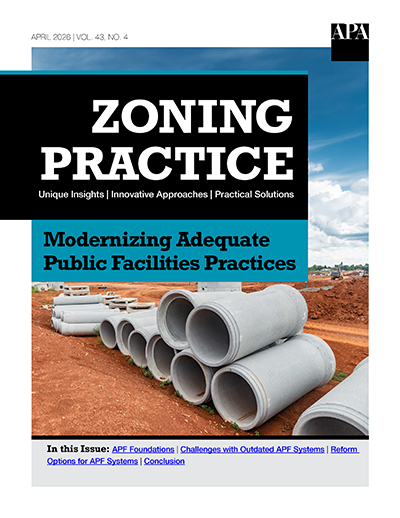
Each issue of Zoning Practice provides practical guidance for planners and land use attorneys engaged in drafting or administering local land use and development regulations. An annual subscription to ZP includes access to the complete archive of previous issues.
Top image: Kirk Fisher / iStock Editorial / Getty Images Plus