


Uncovering JAPA
Integrating Wildfire Planning
JAPA turns research into action. All APA members have access to JAPA and its full archive.
summary
-
A comparison of planning approaches in Chile and Victoria, Australia, found that permits help manage wildfire risk but rarely prevent development in hazardous areas.
-
Other resilience tools, such as buy-back programs and infrastructure improvements, are often underused in both regions.
-
The study calls for integrating wildfire risk into land use planning earlier through stronger policies, coordination, and risk assessments.
In February 2009, Australia endured a major wildfire known as Black Saturday. The fires burned 1.1 million acres, killing 173 people and over 11,800 head of livestock. Chile faced similar devastation in January 2017, when multiple wildfires burned 588,000 acres of forest, causing the evacuation of thousands. Australia's and Chile's disasters are just two chapters in a growing story of wildfires encroaching on human settlements worldwide.
Wildfire risks can be reduced through a variety of planning tools. International documents highlight the importance of integrating wildfires into spatial planning tools, yet there is limited practical and nuanced guidance on how to do so.
In "Advancing Spatial Planning for Wildfire-Resilient Settlements: Insights From Chile and Victoria (Australia)" (Journal of the American Planning Association, Vol. 92, No. 1), Constanza Gonzalez-Mathiesen bridges the gap between stated needs and practical inexperience.
Gonzalez-Mathiesen relies on 18 planning documents at various levels, along with semi-structured interviews with 42 planning officials and planning-involved community representatives. By comparing findings across cases in Chile and Victoria the author identifies common patterns in how these planning tools work, what role they play in reducing wildfire risk, and what would help them better account for wildfire concerns when making planning decisions about specific locations.
A Hard Look at Permits
Permit processes can ensure new development is designed and constructed to withstand wildfires. By reducing stakeholder influences and integrating relevant agencies, permits operationalize resilience planning to site-specific contexts.
While permits can be denied when wildfire risk is too high, the focus is usually on managing that risk rather than avoiding it altogether. As a result, permits are almost never rejected due to wildfire risk.
The tool is plagued by obstacles, including decision-makers' lack of detailed, location-specific wildfire data. Vague rules handed down from higher levels of government make it difficult to challenge risky construction sites, and outside interests can shape permit decisions. One interviewee noted, "If you push hard enough, you'll get a permit."
In Victoria, the planning permit process requires applicants to develop a context-specific wildfire assessment for their site and the surrounding landscape. Chile requires far less in its permit applications. There is no legislative definition of a wildfire risk zone, how to designate it, or how to set up mitigation controls. Risk assessments are only considered at the communal or intercommunal scale by statutory instruments, with no context-specific wildfire assessment.
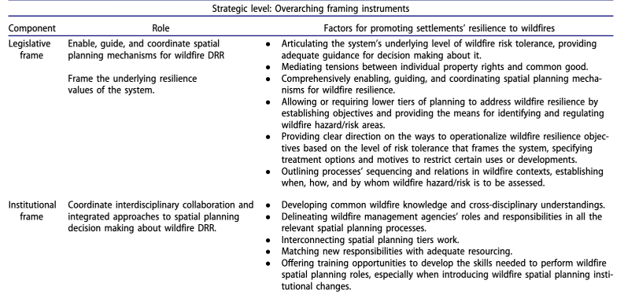
Figure 1: Tools included in this research, their roles, and how they contribute to wildfire resilience. (Credit: Author)
Beyond the Permit
At the site and settlement level of these case studies, wildfire controls are operationalized almost exclusively through permitting. Alternatives abound, including land reclamation, buy-back schemes, infrastructure projects, and retrofitting strategies. Planning tools can leverage both legislative and institutional frameworks to support wildfire resilience (Figure 1). Yet other tools are rarely used, and Gonzalez-Mathiesen sought to determine why.
A lack of integration between tools could be one major obstacle. Many other tools do not consider wildfire risk in their decision-making processes or do so too late. In these case studies, planning agencies did not initiate other mechanisms for wildfire risk reduction. When deployed, these alternatives are used in isolation, limiting their effectiveness.
In Chile, property titles were granted to residents of informal settlements without considering disaster risk or mitigation strategies. In Victoria, a statutory tool is used to identify inappropriate subdivisions for restructuring but is rarely applied to wildfire risk reduction.
Anecdotal examples from the case studies indicate that development and infrastructure can be used to operationalize wildfire resilience objectives. The reconstruction of wildfire-affected Santa Olga, Chile included consolidation of the drinking water system, road network improvements to facilitate response activities, and a park on a settlement's edge.
Integrating Wildfires into Planning
Chilean and Victorian strategic, tactical, and operational planning instruments only partially and inconsistently incorporate wildfire considerations.
The author advocates for integrating wildfire considerations into land use and development decisions from the very beginning - not as an afterthought. That means ensuring the agencies responsible for wildfire management have a seat at the table early in the process. These planning tools need to be paired with financial incentives for landowners and programs that give land a new purpose after development is restricted.
Legislative and institutional frameworks are needed to integrate wildfire risks into spatial planning. Consistent criteria can improve wildfire assessments, strategic plans for safe development, and statutory plans to control land use. Urban development projects, land reclamation and buy-back schemes, and retrofitting strategies can complement the planning permit process.
Top image: Photo by iStock/Getty Images Plus/ AlexandreFagundes
ABOUT THE AUTHOR