

2026 Resilience & Sustainability Award
NYC Urban Forest Plan Maps Greener, More Resilient Future
NYC Mayor's Office of Climate & Environmental Justice, NYC Parks, and City Parks Foundation
summary
- New York City's first-ever Urban Forest Plan is recipient of the 2026 APA National Planning Award for Resilience & Sustainability.
- The plan sets a goal of expanding tree canopy to 30% citywide by 2040 to help mitigate extreme heat, improve public health and strengthen climate resilience.
- LiDAR mapping and canopy modeling help planners identify where trees are being lost, target planting where they will have the greatest impact and address disparities in tree coverage.
New York City could experience an average of 35 days a year with temperatures above 95 degrees Fahrenheit by the 2050s, compared to just four days in recent history. As extreme heat becomes more frequent, the city's streets, buildings, and other infrastructure can absorb and retain heat, making the urban heat island effect even more challenging.
The city is turning to one of its oldest forms of natural infrastructure: trees. The city developed its first-ever New York City Urban Forest Plan, establishing a roadmap to expand tree canopy to 30% citywide by 2040. The plan brought together more than 20 city agencies and a wide range of nonprofit, technical, and community partners. WXY architecture + urban design led the planning, research and design, developing its strategies and overall framework.
How New York City is Preparing for a Hotter Future
Scientists with the U.S. Forest Service estimate that the city's trees provide at least $110 million in annual benefits through carbon sequestration, reduced runoff, air pollution removal, avoided health costs and more.
Today, about 23.4% of New York City is covered by tree canopy, but the benefits of that canopy are far from evenly distributed, reflecting historical patterns of development and structural disinvestment. Environmental justice areas of the city, where low-income communities and communities of color have historically faced disproportionate environmental burdens, have about 19% of tree canopy overall, compared with 26% in non-environmental justice areas.
The goal isn't simply to plant trees wherever space is easiest to find. Instead, the Urban Forest Plan prioritizes preserving existing canopy and expanding it through new planting in neighborhoods with the lowest canopy and greatest need.
A Plan Built Around Three Pathways
The Urban Forest Plan focuses on three pathways:
- Preserve tree canopy — Protect existing trees and improve their care.
- Plant more trees — Expand planting on private property and high-impact public sites.
- Cultivate stewards — Build a network of residents, organizations and agencies to care for the urban forest.
Together, the pathways include 12 strategies and 43 actions that will guide the city's work over the next 10 years. The plan provides a clear framework and roadmap to the many private and nonprofit sector stakeholders who can support these efforts.
Finding Where Trees are Being Lost and Where to Plant
To understand where the city should focus its efforts, planners first needed a detailed picture of how New York's urban forest is changing. Since 2010, the city has used LiDAR (light detection and ranging) scans every five to seven years to track changes and tailor strategies, creating detailed maps of the city.
By comparing LiDAR data from 2017 and 2021, the team found about 8,000 acres of canopy gained and 5,700 acres lost — a net gain of about 2,300 acres. At the citywide scale, one- and two-unit residential properties were the only property type to experience a net loss, revealing where the city is most vulnerable to continued canopy decline.
Growing Opportunities
Much of the opportunity for future canopy expansion is on private property, making partnerships with and support for property owners and other landholders essential. The plan uses "practical canopy" modeling from scientists at The Nature Conservancy to identify where trees can realistically be planted based on available space, land uses and existing infrastructure.
New York City Housing Authority (NYCHA) properties are another opportunity, with more than 1,000 acres of existing canopy. The plan calls for additional planting on campuses with low canopy and available planting space, emphasizing communities with the greatest need.
Together, these findings support a more targeted approach to expanding the urban forest — preserve trees where canopy is being lost and prioritize new planting where it can have the greatest impact.
Building an Urban Forest with New Yorkers
More than 8,000 New Yorkers helped shape the Urban Forest Plan through workshops, tours, focus groups and an online questionnaire across all five boroughs. More than 20,000 comments were received to help identify priorities, including more equitable tree coverage, healthier trees and better access to natural spaces.
But planting and protecting trees is only part of the challenge. The plan also focuses on building a network of residents, organizations and agencies that can care for the urban forest over time, including through youth programs, volunteer opportunities, and urban forestry education and career pathways.
The result is a plan that brought together community engagement, data analysis and interagency coordination that treats trees as long-term infrastructure investments.
2026 Resilience & Sustainability Award
New york city urban forest plan
NYC Mayor's Office of Climate & Environmental Justice, NYC Parks, and City Parks Foundation
New York City, New York
Project Partners
Additional Partners: Members of the nearly two dozen NYC agencies who contributed time, expertise, and input to the UFP.
Project Partners & Consultant Team: City Parks Foundation & Partnerships for Parks, Natural Areas Conservancy, The Nature Conservancy, WXY architecture + urban design, and Urban Canopy Works.
Additional Contributors: U.S. Forest Service, Forest for All NYC, and Trees New York.
Funding provided, in part, by the City of New York, the U.S. Department of Agriculture (USDA) Forest Service Urban and Community Forestry Program in partnership with American Forests; The Leona M. and Harry B. Helmsley Charitable Trust; and the Anahata Foundation.
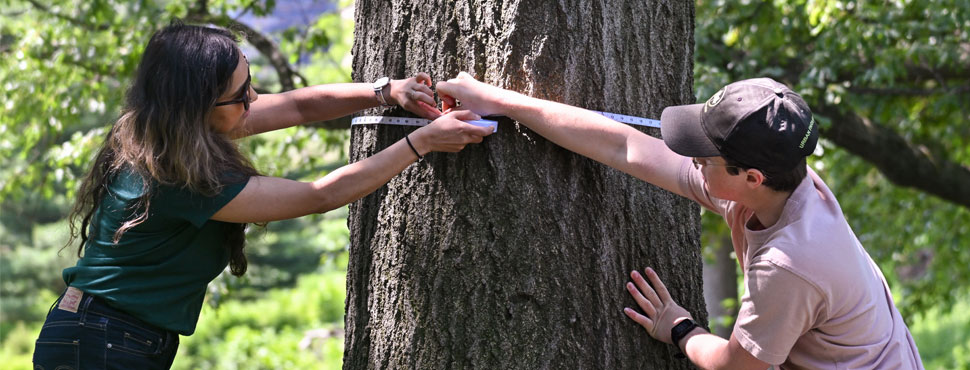
Top image: Courtesy of the New York City Urban Forest Plan team.
ABOUT THE AUTHOR