

April 2, 2026
Nearly two centuries after the U.S. government illegally sold 1,280 acres of land in northern Illinois, Joseph "Zeke" Rupnick is seeing the return of the property that once belonged to Potawatomi Chief Shab-eh-nay, Rupnick's fourth great-grandfather.
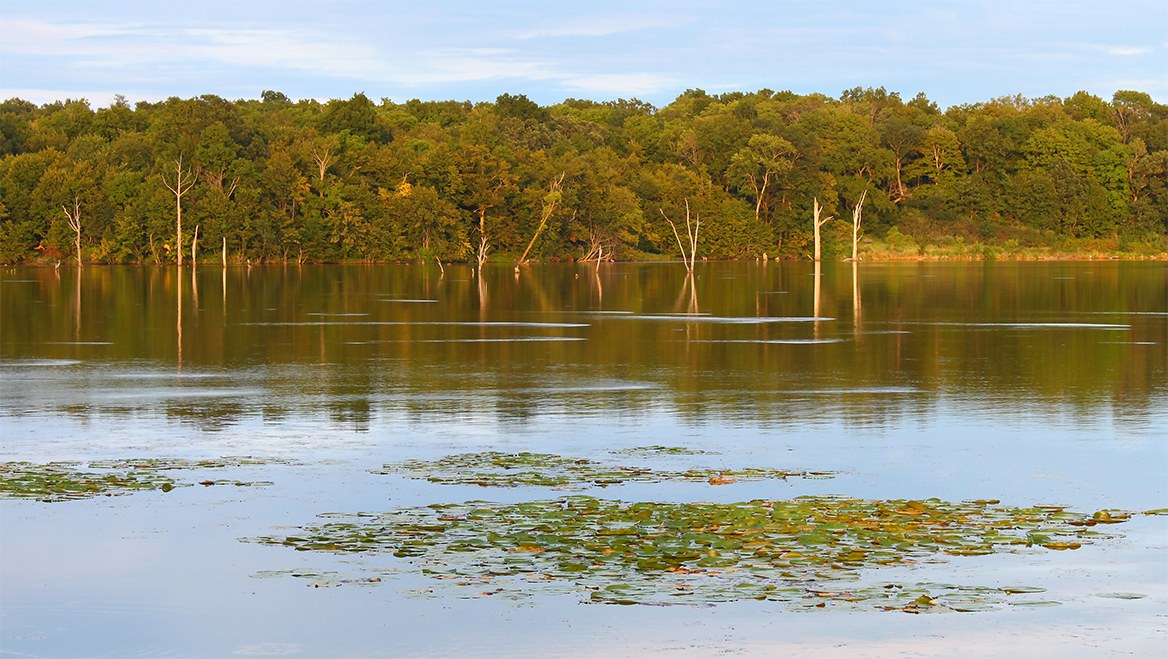
But Rupnick feels mixed emotions when he looks at the still waters of the human-made lake, surrounded by oak, hickory, and the last surviving sugar maple trees, in Shabbona Lake State Park in DeKalb County.
In 2025, Illinois set the first Land Back precedent in the state by agreeing to transfer ownership of the state park back to the Prairie Band Potawatomi Nation. The process, however, has been stalled for the past year, because the park was constructed using conservation funds in the 1970s under legislation that strictly regulates the transfer of land. The tribe is requesting that the Department of Interior waive those funds used by the state to finalize the transfer.
"Nothing that is worth something is very easy," says Rupnick, the tribal council chairperson. "I want to thank all the folks that helped move that legislation forward. It was touch-and-go for a while."
For planners and local governments in Illinois, Land Back — an Indigenous-led movement to return land to Native communities — is new territory. Tribal and state leaders say the transfer of Shabbona Lake State Park represents a significant step toward reconciling historical wrongs and emphasizes that successful partnerships hinge on mutual trust.
"We need to have awareness and understanding of what's there," says Valerie Berstene, AICP, AIA, senior planner at the DLR Group in Chicago. "While communities are starting to do land acknowledgments, it's crucial to understand land's history beyond European settlement. Putting that into our planning documents is recognizing Indigenous experiences and presence in our communities."
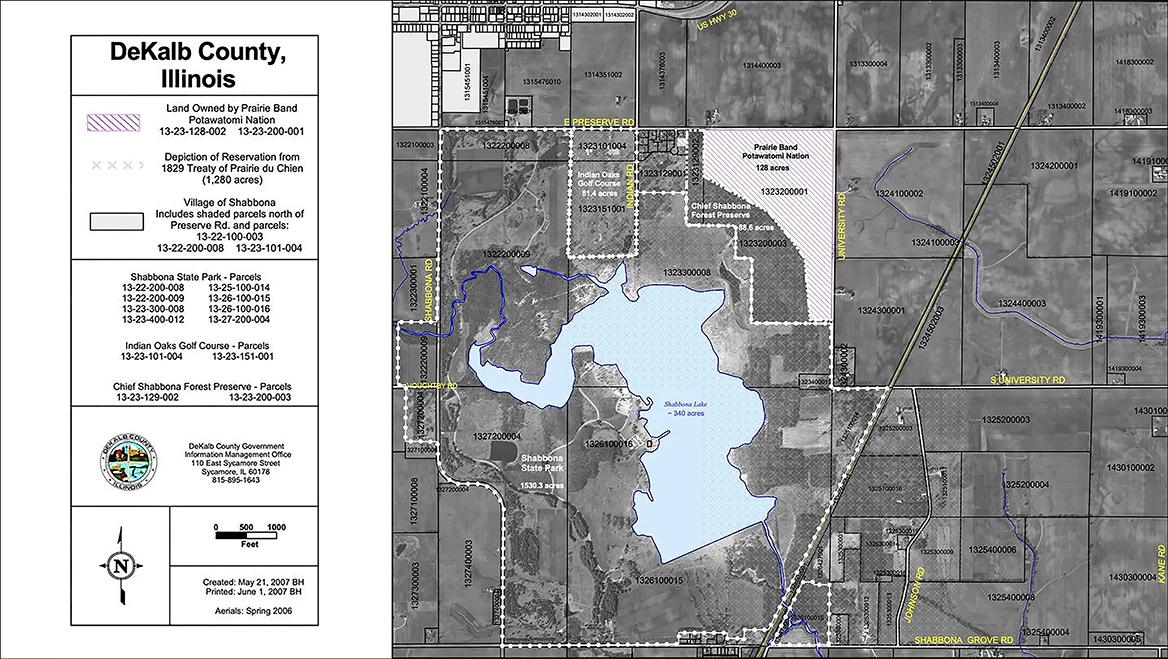
A map shows the 130 acres of land the Prairie Band Potawatomi Nation purchased in DeKalb County (in pink) next to the depiction of their property from the 1829 Treaty of Prairie du Chien (in white crosshatches). Source: DeKalb County Government Information Management Office.
Reclaiming lost land
State Rep. Will Guzzardi, of Chicago, immersed himself in Land Back while working on Senate Bill 867, the legislation that paved the way for the land transfer. "It felt like an opportunity to be a part of American history and righting some of the most egregious wrongs of our history," he says. "This land clearly belongs to the Potawatomi Nation."
In the late 1820s, Chief Shab-eh-nay was granted 1,280 acres under a treaty promising the land to his family forever. When many Potawatomi were forced west under the 1833 Treaty of Chicago, his land was excluded. But in 1849, while Shab-eh-nay briefly visited his community in another state, Illinois officials sold his land at public auction. Although Shab-eh-nay challenged the seizure in court, federal officials upheld the sale, claiming his temporary absence constituted abandonment.
The tribe has long argued that the sale was unlawful, and Congress never authorized the transfer. More than 150 years later, the Department of the Interior acknowledged the tribe's valid legal claim and later recognized the sale as wrongful. In April 2024, 130 acres that the tribe repurchased from the original reservation were placed in a federal trust, which officially restored reservation status in Illinois. Once the transfer of the state park is finalized, the entirety of the park also is expected to be incorporated into the reservation, but it will remain open to the public.
For Berstene, the Shabbona Lake transfer was an entry point in understanding Land Back and how planners can play a role in the movement. After learning about Senate Bill 867 through Guzzardi's newsletter, she asked him to co-lead a presentation with her at the Illinois Chapter of the American Planning Association's 2025 conference.
Curiosity and cursory research about Indigenous people can go a long way for non-Native planners interested in Land Back, Berstene says. Native communities "exist in our cities more than we might be aware of," and organizations and properties may have overlooked histories that affect Indigenous people.
Planners can "think critically about if a past wrong can be undone in some small way through the work we do," she says, whether that's working with a tribe to create plans for land use, zoning, or co-management agreements.
'Our responsibility to steward the land'
While Land Back is new to Illinois, similar initiatives have unfolded across the country for decades. In Mendocino County, California, multiple tribes fought for years to reclaim thousands of acres of redwood forests.
Morning Star Gali, a member of the Pit River Tribe and founder of Indigenous Justice, witnessed those efforts firsthand. Her family became involved with Land Back when she was a child, helping return 523 acres to the InterTribal Sinkyone Wilderness Council, which created the first intertribal protected area in the U.S.
"This is more than a hashtag, more than a slogan, Gali says. "This is a movement we have been doing for decades."
As a former tribal historic preservation officer, Gali worked on several Land Back efforts through U.S. Forest Service collaborations, tribal purchases, and stewardship agreements with Pacific Gas & Electric (PG&E). "Through the years, in our efforts to protect sacred places, the best-case scenarios are returning those lands to the tribes responsible for protecting and managing them," she says.
A landmark agreement will return the ancestral land of the 'O Rew Redwoods Gateway to the Yurok Tribe for stewardship.
But it goes "a little bit deeper than just the land itself," Rupnick adds. "We've got to make sure we're protecting our ancestors and what they held." Gravesites and ancestral remains were disturbed by the construction of the dam that created Shabbona Lake, as well as other sites that needed protection under the Native American Graves Protection and Repatriation Act.
Only a few months after Senate Bill 867 was signed into law in Illinois, California's largest Land Back deal came to fruition: the Yurok Tribe's May 2025 acquisition of 47,097 acres along the Klamath River.
Rosie Clayburn, the Yurok tribal heritage preservation officer, helps lead initiatives to reclaim ancestral territory, including 'O Rew Redwoods Gateway. The project will return 125 acres in what was formerly the Redwood National and State Park Visitor Center to the Yurok Tribe for stewardship through a first-of-its-kind co-management agreement with Redwood National and State Parks.
Limited resources in rural communities remain a major challenge, Clayburn says. Because local governments don't always have support to work with tribes or implement Indigenous law, she recommends finding partners in local Indigenous organizations and attending trainings to learn more.
Establishing trust between local governments and Indigenous tribes is essential. "There's laws and practices we have to follow, but those only get us so far," Clayburn says. "We, as the tribe, have to trust that you're going to do the right thing, and you have to trust us."
Berstene believes planners must rethink their relationship to land itself. "It can be hard for us to wrap our contemporary brains around the way we understand the world, where land is defined as real estate and has value and ownership," she says. To make planning truly equitable, we can ask, "Who stewarded this land before?"
RECOMMENDED ARTICLES