

May 28, 2026
Allison Stewart-Harris, AICP, can pinpoint the exact moment she was done with dots.
Several years ago, while brainstorming with a colleague about community engagement ideas for a client's meeting, she was told to just use a standard dot exercise — having residents put a sticker next to their preferred choice. The reason? It was easiest.
"It was a disaster," recalls Stewart-Harris, then-associate principal and planning studio manager at TSW, an Atlanta-based firm. "The meeting went poorly. The client was unhappy, and I was personally really annoyed. We spent all this time brainstorming cool stuff, and we wound up doing the dots."
That's when Stewart-Harris made up her mind: She wasn't using dots again. "I think the way planners have done engagement has gotten very stale," she says. "As a design firm, we're supposed to be creative. It is not creative to bring a bunch of dots."
In summer 2023, Stewart-Harris got a chance to try something fresh. TSW was hired by Gwinnett County — a growing, diverse area northeast of Atlanta of more than a million people — to help with a comprehensive plan project. The consultant was tasked with getting feedback from about 80 communities representing some 180 different nationalities.
"We needed a menu," Stewart-Harris remembers thinking.
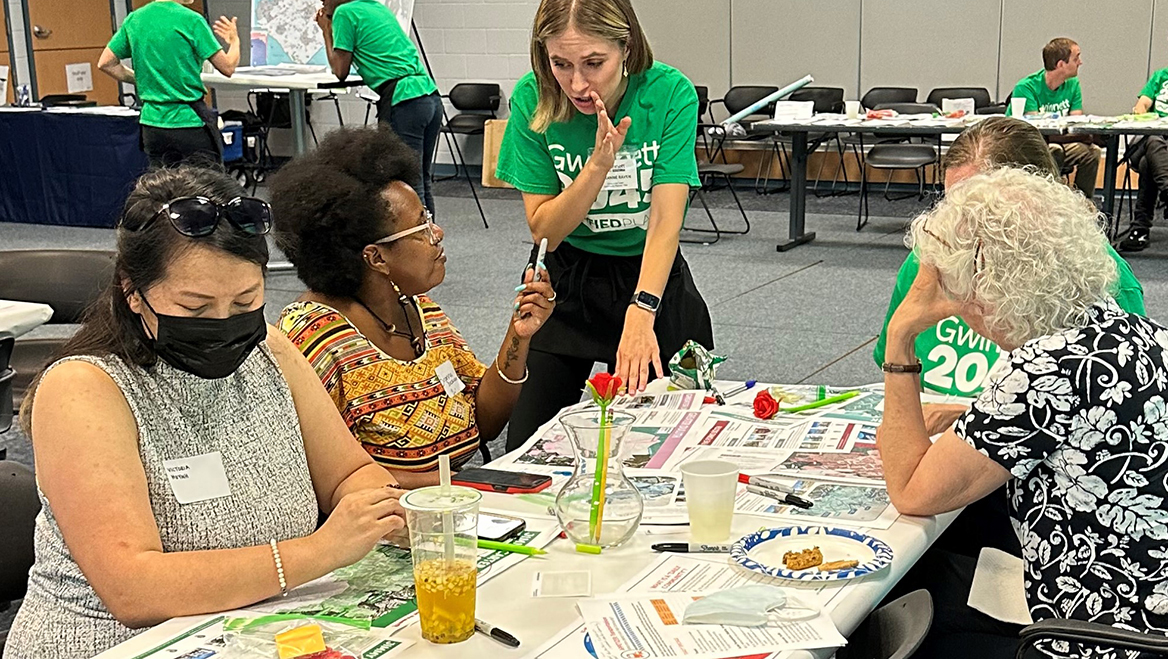
The Daily Community Cafe created a restaurant atmosphere, with flowered pens, a circular menu, and TSW planner Roxanne Raven (center), AICP, and others acting as waitstaff. Photo courtesy of TSW.
An idea formed. What if community members could see all the options laid out before them, like you might find on a sushi menu? Land use was a huge focus, but other required elements also had to be addressed, like economic development, housing, and transportation. "Those became different parts of the menu," says Nick Johnson, AICP, a former TSW planner who worked on the project.
Through this thought process, the Daily Community Café was born. Participants walked into a retail space decorated to look and feel like a restaurant. They were handed a menu and directed to a table with a bouquet of flowers — doubling as pens — and asked to make their way through three "meals" featuring different questions. The wait staff was made up of TSW planners.
"It went really well, it was a lot more fun, and we had these really great conversations," says Stewart-Harris. "After that, I felt like we put this idea in our back pocket. It started with Gwinnett County and then exploded into a bigger thing."
The Year Without Dots, as it would later be called, was upon them.
Breaking the dot addiction
To better understand why the TSW team broke up with dots, it's important to know that they don't actually hate them. "It can be preferred by clients, because you do end up with a visual," says Johnson, who is now programs director at the Georgia Conservancy.
Dots also can be cost-effective for clients, because it doesn't take a lot of the consultant's time or materials. "You're basically asking, 'What do we want information on?' Vote yes or no," says Stewart-Harris, who is now director of long-range planning for Gwinnett County. "I think that's one of the reasons I disliked dots in the first place — the simple yes or no. But you don't know why, right? There's no explanation, so it is hard to actually do anything with it."
After TSW's success with the Daily Community Café, they had proof of concept that going dot-less could work. They also had team members, like Allison Sinyard, AICP, who were working on similar user experience (UX) projects — trying to understand how clients interacted with TSW's services.
So, a year after the café experiment, the TSW planners pledged to stop using dots. Some signed a paper, and others even took videos of themselves reciting the words. "We helped keep each other accountable," says Jill Ferenc, AICP, a senior associate at TSW.

Courtesy of TSW.
From August 1, 2024, to August 1, 2025, they agreed to "abstain from using dots"; provide their communities with "better, more fun things to do at meetings"; and provide clients with "more creative input ideas for advancing their projects and the community's vision." They vowed not to use squares, stars, or other shapes "under the false pretense that they are not actually dots," and they even alerted their subconsultants and clients about the pledge, so everyone was on the same page.
One of those clients was Fairburn, Georgia, a city of 18,000 near downtown Atlanta, where the team was hired to help with a comprehensive plan update.
The city wanted to align its policies with a new community vision, "recognizing that Fairburn has grown significantly" since its last update, says Denise Brookins, AICP, the city's planning and zoning director. Specifically, they hoped community engagement would reach a broader cross-section of residents, create more meaningful conversations rather than transactional feedback, and ensure residents felt informed and optimistic about the future.
Sinyard, who worked on the project, says the city was well built out, so they needed to focus on redevelopment. "We needed to get some buy-in on what a potential land use scenario there looks like," she says.
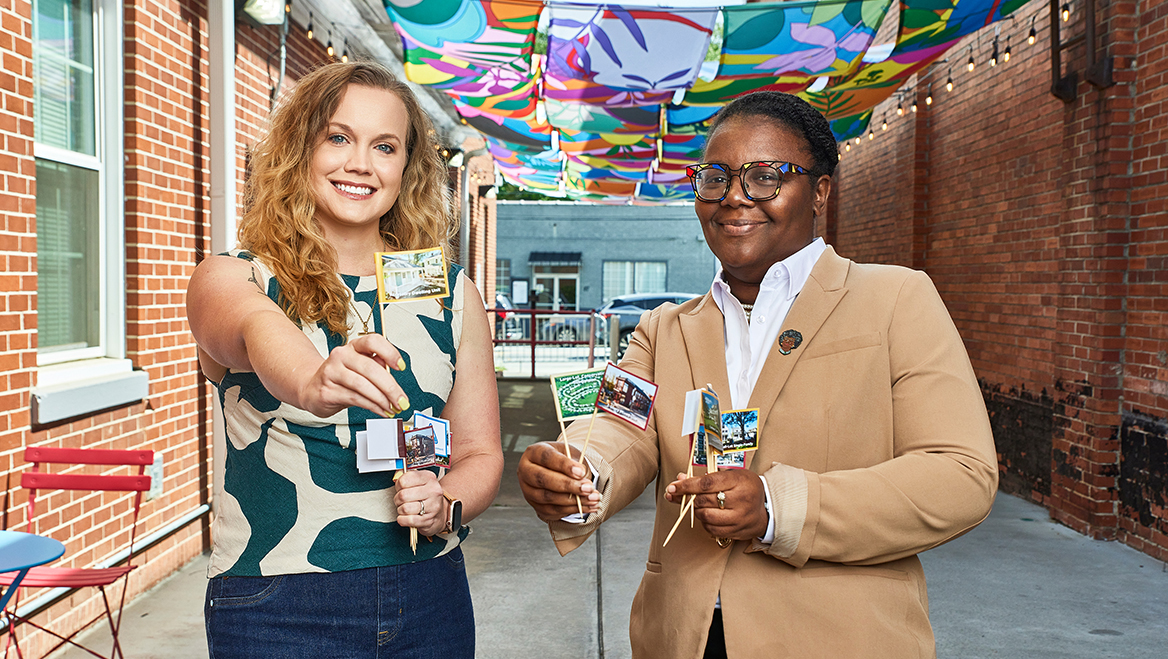
They created the "Plant Your Flag" activity, writing out development types on tiny flags, each representing a priority, use, density, or idea that mattered to community members. Then, they invited participants to place the flags on a map. "This created space for storytelling and context, allowing the planning team to understand the reasoning behind community priorities," Brookins says. "The activity shifted the focus from tallying votes to facilitating conversation and capturing values-based input."
Planning is fun, remember?
Hope Pollard clicks through images on her computer of the community engagement events TSW helped with the past two years, her voice crackling with excitement. As the memories replay in her mind, she comments aloud about the diversity of community members interacting with planners during the Year Without Dots.
There's the Vietnamese night market, where they organized a photo booth activity on short notice — complete with signs in the participants' primary language. There's a Spanish-speaking mother, standing beside her young daughter at an open house, answering questions about placemaking in her community. There's a group of teenagers at the library, drawn in by the chance to give their "red flags vs. green flags" about what is or isn't working in their town, but staying to share what they'd like to see more of in the future.
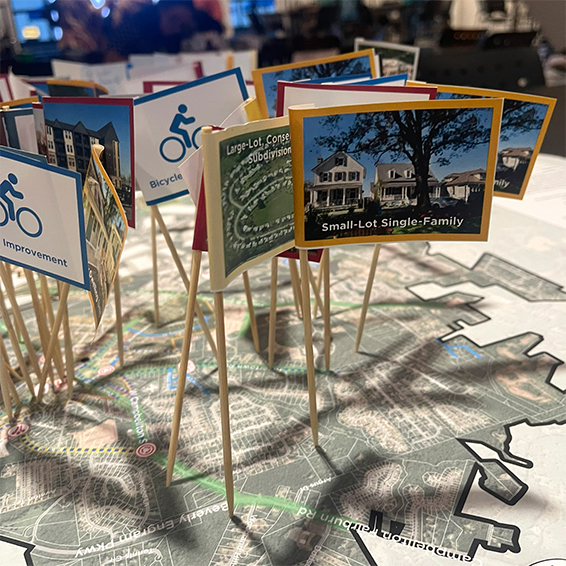
In Fairburn, Georgia, the "Plant Your Flag" event helped the planning team understand the reasoning behind residents' priorities. Photo courtesy of TSW.
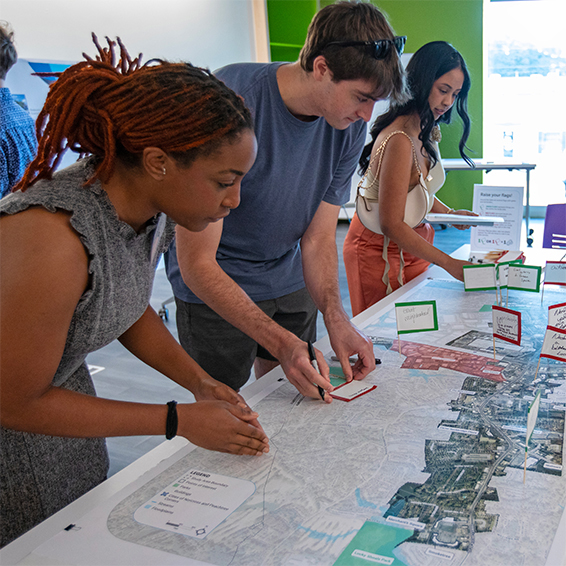
Red and green flags at a public library event attracted teen participants in an activity related to redevelopment, infrastructure, and placemaking. Photo courtesy of Gwinnett County.
As Pollard scrolls through these images, the Gwinnett County senior community planner says it confirms what she already knew. "The beauty of the Year Without Dots is that it's not something that someone can just come to, read a board, put a sticker on, and walk away," she says. "They have to talk to you to participate, and that creates more conversations."
There also were no basic dot activities in Dunwoody, Georgia, a northern Atlanta suburb with a population of 51,000 that brought TSW on to help review its comprehensive plan in spring 2025. The city wanted to know what scale of development community members wanted in certain areas.
Working in their favor was that these conversations didn't have to happen at city hall, because they had access to an empty retail suite at a shopping center in town. When Anna Baggett, AICP, an associate at TSW, learned about the possible site location, she and others on the team leaned into it.
At "Shop Your Vision," participants browsed stations in the store to shop for up to 10 items they envisioned for the community's future, including improvements or opportunities for transportation, economic development, sustainability, housing, land use, or quality of life. Then, they would check out with a member of the planning team, who logged the responses.
"The mayor loved it from the moment she heard about it," recalls Paul Leonhardt, AICP, Dunwoody's planning and zoning manager and community development director. The novel approach helped to "push people into a positive mindset," he adds.
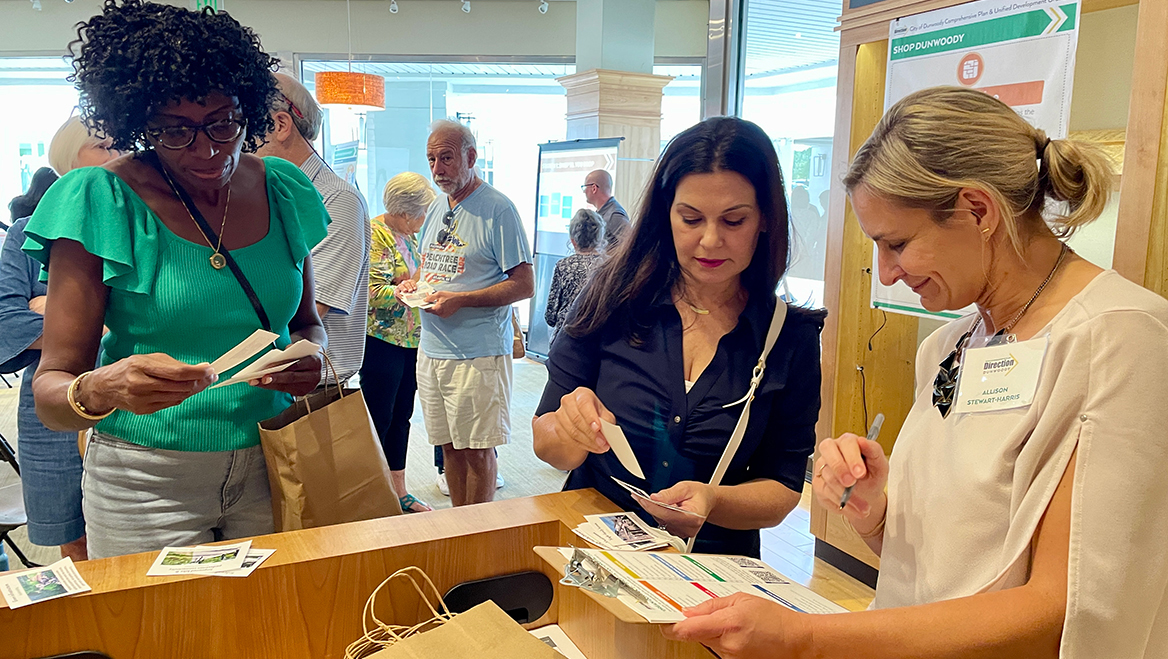
Participants at "Shop Your Vision" chose up to 10 items they envisioned for the community's future before checking out with Allison Stewart-Harris (right), AICP, or other members of the planning team. Photo courtesy of TSW.
Baggett saw that firsthand. Before the event, she remembers being warned that a particularly vocal community member would probably attend and might bring a literal soapbox to stand on. However, the activity's set-up and flow meant no one participant could dominate, says Baggett.
"We were able to have a lot of one-on-one conversations with people who normally didn't speak up, because the meeting format made that possible," Baggett says. And that vocal community member? "She came up to me several times to explain that she was not happy with the activity," Baggett remembers, "but she participated, and I think she did enjoy it."
The Year Without Dots made its way across Georgia. There was a visioning session in Centerville, built around a Mad Libs-style word game; a pin-and-yarn mapping exercise for a transportation plan in Madison; and a Needs and Opportunities Bingo game in a community with a population of mostly older people.
"I think one thing that we really pride ourselves on is that our plans are tailored to the communities we're serving," says Roxanne Raven, AICP, a project manager at TSW. "No two communities are alike, so no two plans are ever alike."
Raven recalls when Red Bank, Tennessee, was unsure what to do with a 12-acre site. Some people wanted it to remain unoccupied, while others wanted redevelopment.
In late summer 2025, the city set up a tent on the lot and staff showed aerials of the site. Participants were invited to design their own site map by placing custom stickers representing different elements, including fountains or water features, tables and chairs, and playground equipment. More than 100 people showed up at Red Bank's "Build Your Own Greenspace" event.
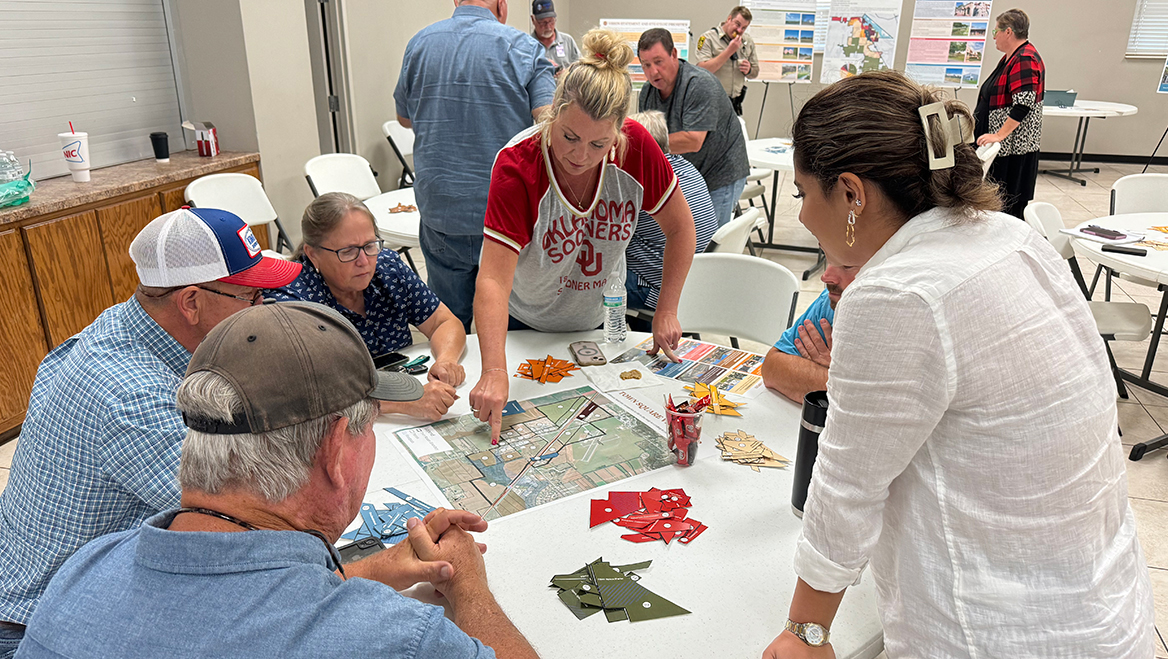
To envision land use options that were available in Goldsby, Oklahoma, participants created personalized maps by selecting puzzle pieces representing types of land use for each parcel. Photo courtesy of Johnson & Associates.
Staff also asked participants to list some of their favorite memories of the space, which was once a middle school. Some wanted to see that recognized somewhere on the site. Others said their favorite memory was that day and getting to meet new people.
"Being able to facilitate community through these events is just the coolest thing," Raven says.
Advancing the community's vision
Somewhere along the way, Raven says she stopped counting the number of new activities they created, but it was at least 30. And even though the year is over, they are still going dot-free when possible.
"It's been a lot of fun," says Sinyard. "I feel like you don't always get to have fun at your job, but I definitely looked forward to going into the office and public engagement more than I used to."
Still, is there space for dots moving forward? "Dot voting can be useful in certain situations," says Brookins, of Fairburn, "but for comprehensive planning and community visioning, more interactive and discussion-based tools often yield richer outcomes."
Brookins sees the Year Without Dots as an example of planners challenging the norm in community engagement. "It's recognizing that meaningful participation requires more than quick votes," she says. "It requires conversation, explanation, and space for people to articulate their hopes for their community."
Pollard, of Gwinnett County, says it helped bring humanity and relationships back to what can often be a bureaucratic world.
"I think planners sign up for this job because we want to learn about and help communities," she says. "But, so often, we're doing development reviews or just trying to get through a project with a limited amount of time, so yeah, we're like, 'Just put the dot on the board and tell me what you want.'
"But the Year Without Dots is like a speed bump. 'Hang on, slow down. What do you actually want?' It forces us to stop and listen — and have those conversations a little more."
RECOMMENDED ARTICLES