

May 21, 2026
Just over four years ago, The Port of Greater Cincinnati Development Authority purchased 194 homes throughout Hamilton County, Ohio. Buying these houses, which previously belonged to a Los Angeles investment firm, was no small task. The Port outbid a dozen corporate investors, spending $14.5 million to acquire the properties as part of the agency's Creating Affordable Real Estate (CARE) Homes Initiative.
Taking ownership was just the beginning. Although the investment firm had a reputation as a negligent landlord, the list of renovations was even longer than The Port anticipated.
Some homes weren't connected to plumbing and had outdated electrical service. Others needed mold removed and roofs repaired. "Only half of them even had air conditioning, or they had decades-old HVAC units," says Philip Denning, executive vice president of The Port. "Lead paint, completely wildly dysfunctional property layouts, no landscaping — I could go on."
While the houses being renovated represent some of the worst-case scenarios, experts say corporate ownership is a nuanced issue. But the number of institutional investors — pension funds, real estate investment trusts (REITs), and other large organizations including banks — that purchase and rent out single-family homes has continued to increase since the 2008 housing crisis, according to Who Owns America, a Lincoln Institute of Land Policy report published last November. Data shows these types of investors bought about 85,000 properties per month between January and June 2025.
"One of the important things is they're not monolithic," says George "Mac" McCarthy, PhD, former president and CEO of the Lincoln Institute. "Some are decent landlords and are buying decent stock ... Then there are the bottom feeders who buy neglected houses, slap on a coat of paint, and walk away."
As concerns about institutional investors' effect on the housing market make headlines, the federal government has acted: In January, President Donald Trump signed an executive order aimed at limiting corporate ownership of single-family homes.
Uncovering investment patterns
Institutional investors own about 3 percent of the U.S. rental housing stock, and these properties are most prevalent in the Sun Belt, according to 2024 Government Accountability Office estimates. Mega-investors with more than 1,000 properties account for 25 percent of single-family rental homes in Atlanta; 21 percent in Jacksonville, Florida, and 18 percent in Charlotte, North Carolina.
Institutional investors generally target markets with high rents and low home prices, low tax rates, and renter laws that favor landlords, McCarthy says. Often, they are in historically under-resourced areas. The Charlotte Urban Institute at the University of North Carolina (UNC) Charlotte noticed that pattern unfold in its own research into corporate-owned properties in the city and Mecklenburg County. "If you look at the South Charlotte area — very affluent neighborhoods — [there are] almost no corporate landlords," says Eric Moore, PhD, a senior research associate with the organization.
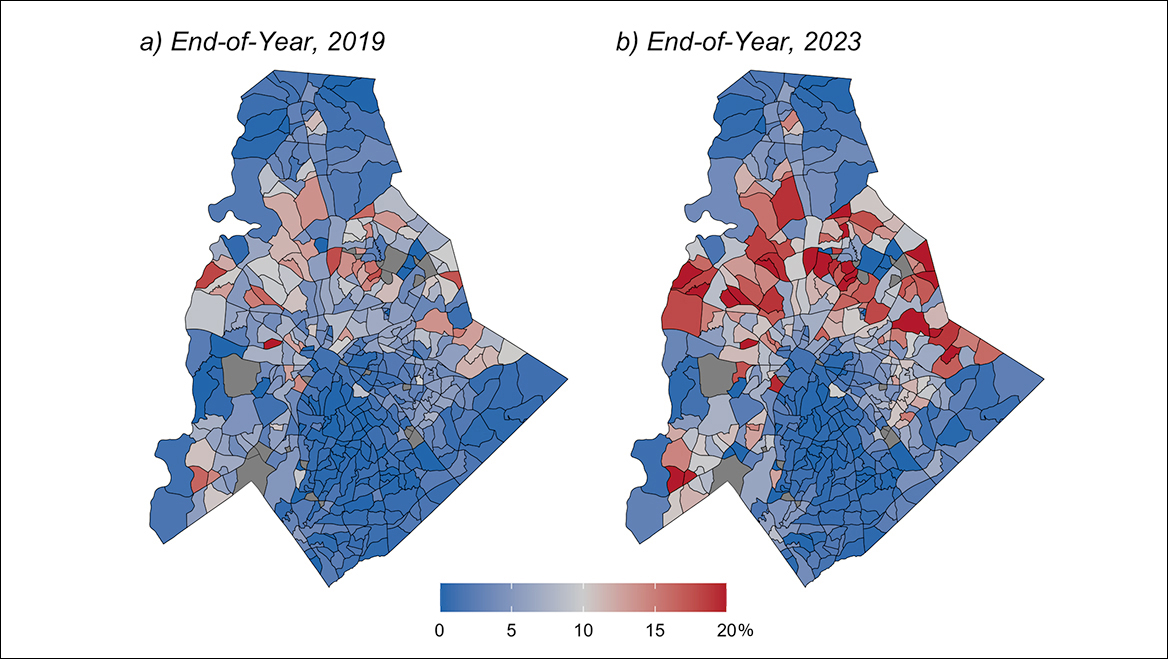
This map shows the percentage of corporate investor-owned homes in similar neighborhoods in Mecklenburg County, North Carolina, before and after the 2020 pandemic. Map courtesy of Charlotte Urban Institute.
Back in Hamilton County, Ohio, institutional investors have helped to drive up home prices, rent costs, and property taxes in several historically underserved neighborhoods, says Denning, The Port's executive vice president. "Altogether, that means, especially on the rental side, the tenants just don't have options," he says. "They're at the mercy of the market."
Before The Port purchased the nearly 200 CARE Homes properties, tenants were on month-to-month leases, which allowed the landlord to end a lease with 30 days' notice as a way of retaliating against instead of resolving complaints. "If they report that there's mold, there's water leaking, that their oven doesn't work, all the institutional investor has to say is, 'I'm sorry, I'm not renewing your lease,'" Denning says. "Now there's a tenant fear of reporting a safety and health livability issue."
Piecing together safety and affordability
Planners and local officials can ensure equitable, affordable housing through several approaches, but the first step is to understand the size and scale of investor ownership in a community, which can be a puzzle in and of itself.
"Institutional investors can have any number of subsidiaries with different names that are not always obviously tied to them," Moore says. The Charlotte Urban Institute spent several months analyzing county data and cross-referencing lists from the Raleigh News & Observer and the North Carolina Secretary of State's office to identify such entities. "It's an interesting wrinkle that you don't normally consider. If you don't have a county or jurisdiction that has up-to-date records, that can be a problem," he says.
To better track corporate-owned housing, municipalities can create a rental registry with the names of the owner, rental history, square footage, and other relevant data. "It gives the city at least a line of sight into their rental housing stock," McCarthy says. That transparency can ensure investor-owned housing undergoes inspections to identify any issues.
"Implementing rental licensing ordinances alongside inspections also can increase accountability for landlords, because repeated code violations or nuisance complaints become grounds for suspending or revoking the license," wrote Alan Mallach, FAICP, in a Zoning Practice article. In Baltimore, for example, non-owner-occupied properties must be registered every year, and inspections are required to renew or obtain a required rental license.
Not every municipality, however, has enough resources for frequent inspections, which is a challenge that Hamilton County is navigating. In one of the townships, there is only one code enforcement inspector, but more than 700 investor-owned properties, says Yasmin Chilton, director of external affairs and media relations for The Port.
"This is happening in townships and jurisdictions that are way smaller than a city that are not resourced to handle an institutional failure of this magnitude," Denning says.
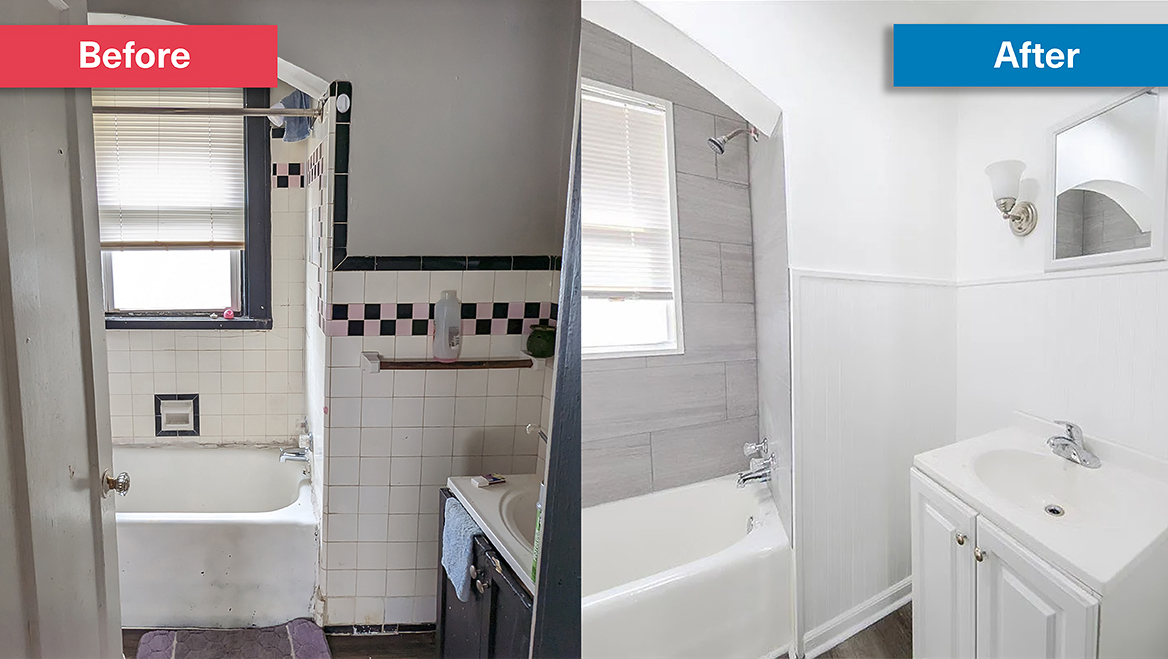
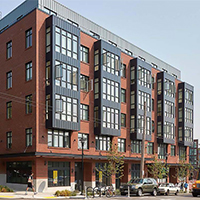
With the help of public, private, and government partnerships, The Port of Greater Cincinnati Development Authority has renovated about 80 homes in Hamilton County to make them safe and affordable. Photo courtesy of The Port and Gunnels Realty.
Rising housing costs and demands remain challenges in Cincinnati, but planners have implemented reforms to increase housing options, such as legalizing accessory dwelling units (ADUs). "I'm always going to go back to the comprehensive plan and talk about the full spectrum of housing options," says Katherine Keough-Jurs, FAICP, Cincinnati's director of city planning and engagement. "I would love for someone who loves their neighborhood to find a place that they can afford to live, no matter what point they are in their life."
Planners and municipalities can use other tools to increase the number of safe, affordable places to live. "The easiest way to increase your housing stock, especially affordable housing, is to build it on public land, because the public sector can dictate what gets built," McCarthy says. Another option is creating permanently affordable housing, such as community land trust or deed-restricted housing, which is more difficult for investors to purchase.
Property tax relief, homeowner assistance programs, and first-time homebuyer incentives also are beneficial, according to Who Owns America. Municipal buybacks, such as what The Port did in Hamilton County, are another option, although Denning acknowledges the high financial cost.
Initially, The Port estimated that repairs would cost about $35,000 per home, but expenses ballooned to about $100,000 for each property. Public, private, and government partnerships were integral before The Port even bid on the houses. "It's a matter of finding those organizations, structures, advocates that are willing to brave the risk, because that's been a gamechanger," Denning says.
The risk has been worth it: Since 2022, 76 homes have been sold at an average price of $161,104 to residents who couldn't afford single-family housing, and 11 more are finished, listed, or under contract. The homes that remain as rentals are now on affordable year-long leases to give renters stability and peace of mind.
"That's almost an immeasurable benefit that we have been providing to people — families with kids that are just trying to live," Denning says. "Homeownership is important and it is our major goal, but all of the near-term work that we've done is one of the most compelling parts of this."
RECOMMENDED ARTICLES