


Uncovering JAPA
More Than Just Tree Canopy: Assessing True Shade Access

summary
- Digital tree equity tools often focus narrowly on canopy distribution, overlooking how factors such as species, placement, infrastructure, and zoning shape whether residents actually receive environmental and health benefits.
- Measuring proximity to trees does not guarantee meaningful access. Social conditions and exclusionary practices, including design decisions in public spaces, can limit who benefits from urban forestry investments.
- Digital tools should be used in coordination with local knowledge and community participation to lead to more effective planting strategies and stronger equity outcomes.
Planners know the problem: tree canopy is unequally distributed across cities, and lower-income and communities of color tend to be left without shade. Digital tools have become a go-to resource for identifying where to plant new trees, but a new study finds that these tools may be reinforcing blind spots to true equity.
In "Just Distribution of Tree Canopy? A Digital Approach to Tree Equity" (Journal of the American Planning Association, Vol. 92, No. 1), Alexandra G. Ponette-González, Matthew Fry, Daniella Hirschfeld, Jeff Rose, and Evan Elderbrock evaluate digital tools for tree equity.
Digital Tools Have Limited Dimension
Commonly used digital tools address only one dimension of equity: the distribution of tree canopy. The authors show how this focus on distributive justice overlooks differences within an urban landscape and may reinforce the exclusions of historically underrepresented groups.
Digital tools conflate the benefits of the tree canopy, access with proximity, and lived experience with socioeconomic and demographic factors.
Benefits vs. Canopy
Most digital tools treat the presence of tree canopy as a reliable stand-in for tree benefits. But canopy cover is only one piece of the picture. Leaf type, ground cover, and the placement of trees relative to emission sources all affect whether residents actually benefit from nearby trees. A row of evergreen trees between a neighborhood and a road can meaningfully reduce particulate exposure; a fruit tree in the middle of a park is unlikely to have the same effect.
Digital tools do not account for:
- Zoning ordinances or housing arrangements that affect tree distribution
- Soil conditions unsuitable for tree planting
- Infrastructure considerations (e.g., overhead power lines and underground utilities)
Digital tree tools need to stop equating canopy cover with tree benefits. More accurate assessments should understand that most oaks do not thrive when planted against tall buildings, while the range of Osage orange trees is expected to expand with climate change.
Proximity vs. Access
More trees do not necessarily mean expanded access to tree benefits. The most commonly used digital tools miss out on this. They continue to rely on measurements of people's proximity to trees. Access is the ability to derive benefits from trees. More than the presence of a tree, access is also determined by someone's social position.
For example, tree planting practices may exclude unhoused people. This can happen intentionally or unintentionally when planning a tree project. Exclusive practices to be aware of include avoiding plantings in an area for fear of encampments, tree removal to deter sleeping, or installing hostile architecture beneath or around trees.
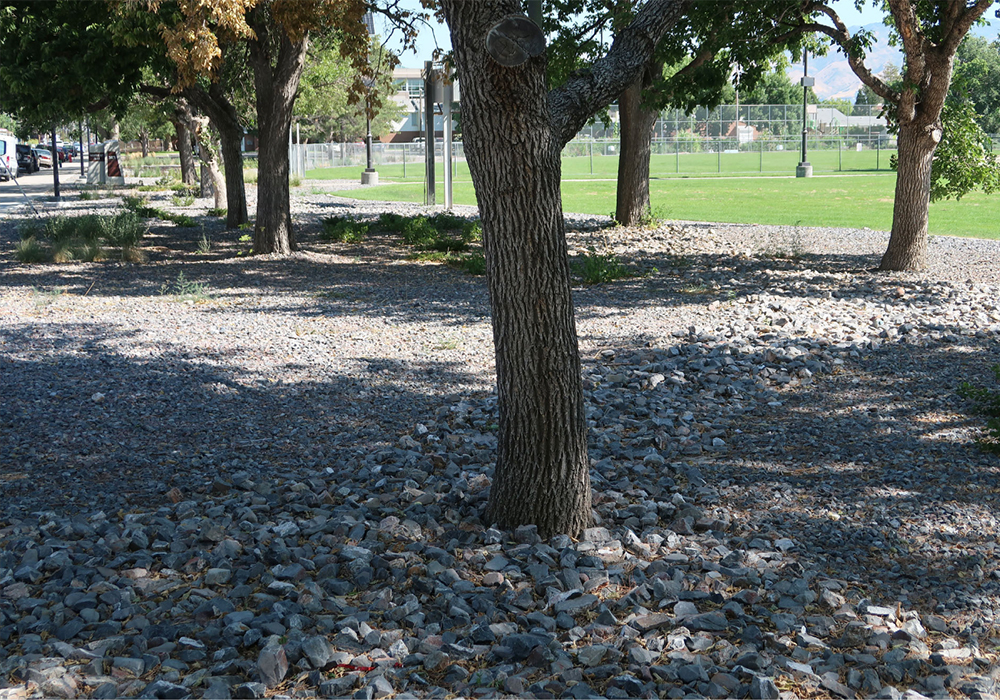
Figure 1: Hostile landscape architecture in a public city park. Cobblestone intentionally installed below trees to discourage people from accessing the shading benefits of trees (Credit: M. Frey)
Pair Digital Analysis with Local Knowledge
The authors do not argue against digital tools; rather, they argue for an integrated approach that layers in local knowledge and participation. The success of tree projects is threatened by these tools' narrow focus on tree canopy and distributive justice.
The authors highlight several ways digital tools can be used to enhance community participation in urban forest decision-making. During the planning process, outdoor workers can contextualize or ground-truth a digital tool's analysis of priority planting locations. After planting, unhoused people might be interested in paid research roles on the health benefits of urban trees. Wheelchair-reliant people and older adults with mobility limitations might share valuable perspectives on barriers to accessing trees.
There are co-developed guidelines for participatory research with underrepresented community members that emphasize agency, reciprocity, and empowerment. Engaged urban forestry can save wasteful plantings by offering refined analyses of where and what kind of trees are most needed. Coupling digital and participatory tools expands notions of tree equity to include participatory justice as well as distributive justice.
Top image: Photo by iStock/Getty Images Plus/ ultramansk
ABOUT THE AUTHOR